
Community in China gets a "robot watchman"
Marie Donlon | March 25, 2019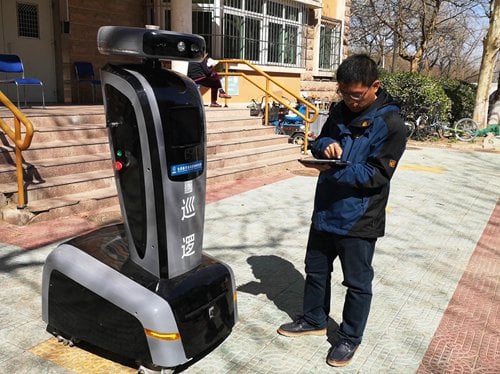 Liu Gangjun, the project director at Beijing Aerospace Automatic Control Institute, operates the robot, named Meibao, in Beijing's Meiyuan residential community. Source: Xu Keyue/GTA residential community in Beijing has a new employee to keep watch for suspicious behavior: a “robot watchman.”
Developed by the Beijing Aerospace Automatic Control Institute (BAACI), the robot called Meibao has been monitoring Beijing’s Meiyuan community for illegal activity using a combination of facial recognition technology, infrared thermal imagery and man-machine communication. Standing at 1.7 m tall, Meibao has cameras for eyes and a display on its chest. Using biological recognition, big data analysis, an inertial navigation system and an assortment of other technologies, Meibao can sound an alarm when a suspicious person appears in the community.
Replacing traditional night watchmen, the robot can also offer residents helpful information such as weather forecasts. It can also tell stories and play music.
The trial of Meibao began in December of 2018 and will last through April 2019, according to reports.
Automating jobs in China using artificial intelligence (AI), robotics and a variety of other technologies is nothing new. With predictions suggesting that at least half of current work tasks will be absorbed by AI by 2025, China is seemingly ahead of the curve employing robot news anchors and kindergarten teaching assistants. Similarly, China is also home to a popular restaurant chain with a kitchen operated almost entirely by AI.



With 1/2 of the current population (1.3 billion) replaced by AI in 2025, will the remaining 650 million become "excess surplus"?
In reply to #1
Soylent green candidates?
I think it's a very uncertain future we are headed into. Not only Solent green, but Terminator or, even better, the Matrix. That's more along the line I see the world headed, especially since they insist on making them self learning! Self learning IS self awareness!! How long until they figure out they don't need or want us around seeing as all we do is kill this planet and each other?! Heck, maybe that's been the grand design all along...