
Underwater Geolocation Technique Takes Cues from Nature
S. Himmelstein | April 09, 2018Thank the mantis shrimp and squid for a recent advance in underwater navigation capabilities for humans. These marine denizens rely on polarized light which humans cannot perceive without the aid of special lenses — to navigate and to improve visual acuity for predator and prey detection. An international team of researchers theorized that imaging equipment that was sensitive to polarizing light could improve the accuracy 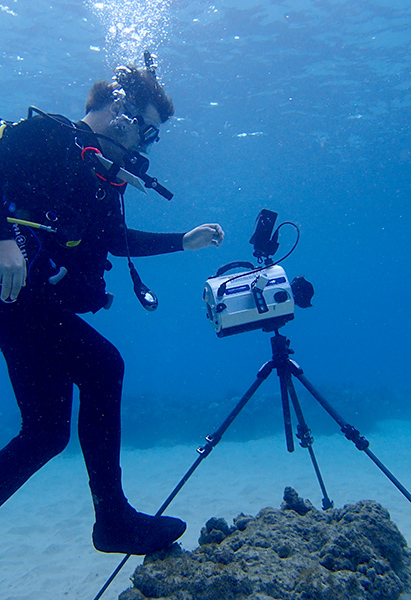 Source: University of Queenslandof underwater navigation for people.
Most modern navigation techniques aren’t applicable underwater. Research submarines use GPS systems at the surface, but satellite-based GPS only works to a depth of about 20 centimeters. When these vessels descend, navigators rely on dead reckoning to calculate their position.
The research team designed polarization sensors to determine the sun's position in the sky based on patterns of light underwater. This equipment would allow for real-time geolocalization underwater with more accurate long-distance results, without the need to resurface periodically. The imaging system could also enable navigation at depths up to 200 meters below the ocean's surface.
Trials at different locations and at different depths and times of day indicate that the average accuracy of the bioinspired proof-of-concept geolocalization system is 61 kilometers, or 6 meters of error for every 1 kilometer traveled.
Scientists from Johns Hopkins University, University of Illinois at Urbana-Champaign and University of Queensland, Australia, participated in this study, which is published in Science Advances.




. . . dead reckoning with the help of inertial navigation systems.
https://en.wikipedia
Not to say that more inputs wouldn't be welcome.