Formal Logic Drives Singapore Autonomous Vehicles
Ed Brown | January 09, 2017Self-driving taxis are poised to be one of the earliest applications of autonomous vehicles.
A trial run is underway on the streets of the One-North business district of Singapore. The experiment is a project of nuTonomy, an MIT spinoff tech startup company.
The software "driving" the taxis helps to differentiate nuTonomy from most other autonomous car companies. It uses formal logic as opposed to machine learning.
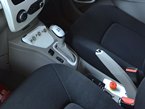 NuTonomy’s car comes with three buttons for manual, pause, and stop.Formal logic is based on a hierarchy of rules. For example, highest priority is given to rules like “don't hit pedestrians,” "don't hit other vehicles," and “don't hit objects.” Lower priority is assigned to rules like "maintain speed when safe" and "don't cross the centerline." Lower still are rules like "give a comfortable ride."
The cars have an array of sensors, including LiDAR on the roof and around the front bumper, and radar and cameras around the vehicle. A planning algorithm called RRT*– a variant of rapidly exploring random tree (RRT) – uses the data from all of the sensors to evaluate potential paths.
Decision-making software evaluates each of the paths and selects the one that best conforms to the rule hierarchy. By contrast, machine learning has the drawback that it is “just like a black box; you’re never quite sure what’s going on,” says nuTonomy CEO Doug Parker.
The rules expressed in the formal logic software clearly define responses to different situations. If a problem shows up, the rules can be modified. A rule-based algorithm also makes it easier to explain the vehicle’s behavior to regulators and to show them the corrections made to prevent a recurrence of a problem.