Deep learning versus continual learning for environmental control
Jody Dascalu | June 02, 2026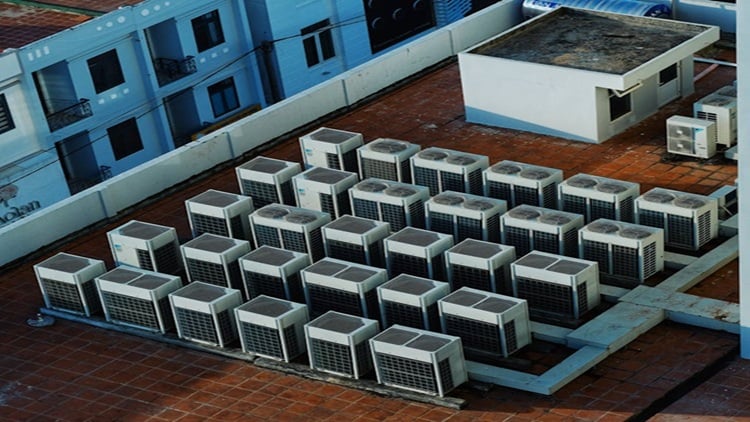 An array of industrial HVAC units sits in a grid on a rooftop. Source: Pexels
The use of artificial intelligence in environmental control systems often centers on two contrasting approaches, static deep learning models and continual reinforcement learning systems. Deep learning models are trained on historical data to predict thermal behavior, occupancy patterns and energy demand. Once deployed, these models remain fixed, providing stable and predictable control but limited ability to respond to conditions that differ from the training data.
Continual reinforcement learning systems operate on an adaptive framework, updating control strategies during live operation. Rather than relying solely on pre-trained patterns, these systems treat environmental control as a dynamic optimization problem and adjust outputs based on real-time sensor feedback and system performance. This allows the system to respond to changes such as shifting occupancy, equipment degradation and variable weather conditions.
The difference between these approaches is primarily a tradeoff between stability and adaptability. Static models provide consistent, low-variance control under known conditions, while continual learning systems introduce flexibility at the cost of increased computational and operational complexity.
Static training models compared to adaptive feedback loops
The performance of deep learning models depends on the scope and quality of the data used during training. These models capture recurring patterns such as seasonal temperature variation and occupancy cycles, enabling stable and predictable control once deployed. Because the model does not change during operation, it provides consistent response times and a stable energy profile, which is valuable in large commercial systems where minimizing variability is a priority.
The same fixed structure limits how the system responds to changing conditions. As buildings age, shifts in airflow, equipment efficiency or insulation alter system behavior, but the model continues to apply its original control logic. This can lead to setpoint drift, inefficient cycling or increased energy use under off-design conditions. Maintaining performance often requires periodic retraining or manual recalibration.
Static models are also constrained by the coverage of their training data. Rare events such as occupancy spikes, atypical weather or equipment faults may not be represented, limiting the system’s ability to respond effectively when they occur. Continual reinforcement learning addresses these limitations by updating control logic during operation, using real-time sensor data to adjust parameters and maintain target conditions under changing or previously unseen scenarios.
Computational requirements and system architecture
The computational demands of each approach shape how control systems are deployed and integrated. Static deep learning models are typically trained in centralized environments using large historical datasets, then deployed as fixed inference models on local controllers. This allows most of the computational load to remain off-site, with on-device processing limited to executing pre-defined control logic. As a result, these systems can run on lower-cost hardware, with minimal latency and straightforward integration into existing building management systems.
Continual learning systems shift more of this computation to the edge. Models must continuously process incoming sensor data and update control parameters during operation, increasing demands on local hardware and memory. This creates additional constraints around processing capacity, response time and system stability, particularly in distributed environments where multiple controllers operate simultaneously.
Real-time adaptation also introduces challenges in maintaining consistent performance. Frequent model updates can lead to instability if the system reacts too strongly to short-term fluctuations in sensor data. To address this, control architectures must incorporate safeguards such as bounded update rates or validation layers that limit how quickly parameters can change. These requirements make continual learning systems more resource-intensive and complex to deploy but enable more responsive control under variable conditions.
Efficiency gains through predictive and self-correcting logic
Energy efficiency in environmental control systems is influenced by how control actions are scheduled and distributed over time. Static models rely on predefined control paths derived from historical data, enabling structured strategies such as load shifting and peak reduction. These approaches help maintain stable energy profiles and avoid sudden demand spikes, which is particularly useful in large systems where predictability and grid interaction are important considerations.
Continual learning systems affect efficiency through incremental adjustment, moving away from fixed scheduling. By continuously refining control outputs based on observed system response, they can reduce reliance on conservative operating margins and limit unnecessary runtime. This results in more consistent alignment between energy input and system demand, while also smoothing control actions to reduce cycling and mechanical strain. These systems adjust energy use as conditions evolve, bypassing the need to optimize for expected conditions alone. This leads to more balanced performance over time.
Performance and reliability under real operating conditions
Operational reliability differs in how these models manage data integrity and response latency. Static deep learning systems offer near-zero latency because control logic is established during the initial training phase. This speed ensures immediate command execution, which helps maintain a baseline in facilities with high thermal mass and predictable usage. The risk lies in the model's rigidity when hardware issues arise. If a primary sensor drifts or provides noisy data, a static model cannot verify the input against real-world outcomes. It continues to execute logic based on faulty data, often leading to mechanical overcompensation and unstable conditions.
Adaptive systems manage reliability by treating sensor data as a variable to be verified. Since these models monitor the relationship between control actions and environmental changes, they can detect when an input fails to produce the expected physical result. This creates resilience against equipment failure and sensor degradation. While these systems require an initial learning period to stabilize, they provide higher long-term precision by reconciling digital inputs with actual system performance. This makes them more effective for managing environments where thermal dynamics are volatile or equipment reliability varies.
Hybrid approaches and future direction
The industry is identifying a practical middle ground in the combination of static deep learning models with adaptive layers. In this structure, a pre-trained model provides a stable baseline to ensure the system operates within safe mechanical limits. A secondary adaptive layer then fine-tunes parameters in response to real-time variables like occupancy shifts or equipment wear. This configuration allows for continuous optimization without the stability risks associated with fully autonomous systems.
Future system architectures are also leaning toward more distributed control. By shifting processing to localized zone controllers, buildings can perform targeted adjustments that improve overall resilience and reduce reliance on a central system. As these technologies mature, the development of environmental control is trending toward these hybrid, decentralized models that attempt to balance proven reliability with the benefits of active optimization.