This camera can see deep into the universe
David Wagman | August 26, 2019After 16 years of planning and engineering, scientists at the U.S. Department of Energy’s (DOE) Brookhaven National Laboratory have completed a 3.2 gigapixel sensor array for a camera that will be used in the Large Synoptic Survey Telescope (LSST), a telescope being built on a mountaintop in Chile that will observe the universe.
The digital sensor array includes roughly 200 16-megapixel sensors, divided into 21 modules called “rafts.” Each raft can function on its own, but when combined, they will view an area of sky that can fit more than 40 full moons in a single image. Researchers will stitch these images together to create a time-lapse movie of the complete visible universe accessible from Chile.
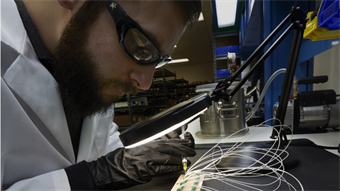
 SLAC National Accelerator Laboratory installs the first of Brookhaven's 21 rafts that make up LSST's digital sensor array. Source: SLAC National Accelerator LaboratoryCurrently under construction, LSST is designed to capture some of the most complete images of our universe that have ever been achieved. The project is a collaborative effort among more than 30 institutions from around the world, and it is primarily funded by the DOE’s Office of Science and the National Science Foundation.
(Read "Hubble telescope celebrates 28 years in space with a stunning capture.")
The DOE’s SLAC National Accelerator Laboratory is leading the overall effort to construct the camera — the world’s largest camera for astronomy. Brookhaven led the design, construction and qualification of the digital sensor array, which can be thought of as the “digital film” for the camera.
Brookhaven began its LSST research and development program in 2003. Construction of the digital sensor array began in 2014. Leading up to construction, Brookhaven designed and fabricated the assembly and test equipment for the science rafts. The lab also created an automated production facility and cleanroom, along with production and tracking software.
(Read "Hubble space telescope: The bad, the ugly and (finally) the good.")
Design flaw
The LSST team at Brookhaven completed the first raft in 2017, and discovered a design flaw. Specifically, design features led to the possibility that electrical wires in the rafts could short out. The rate at which this was affecting the rafts was on the order of 0.2%, so engineers refit almost every raft to correct the problem.
Now, two years after the start of raft production, the team has built and shipped the final raft to SLAC for integration into the camera.
As the telescope undergoes its commissioning phase, Brookhaven scientists will serve as experts on the digital sensor array in the camera. They will also provide support during LSST’s operations, which are projected to begin in 2022.