Biosensor Monitors Oxygen in Organ-on-a-Chip Systems
S. Himmelstein | August 23, 2018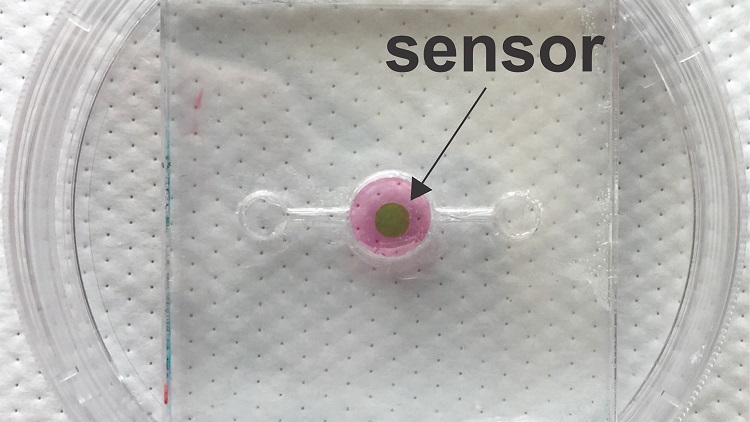 The biosensor tracks oxygen levels in real time in organ-on-a-chip systems. Source: Michael Daniele/ North Carolina State University, University of North Carolina, Chapel Hill
A new photonic biosensor developed at North Carolina State University and the University of North Carolina, Chapel Hill, tracks oxygen levels in real time in organ-on-a-chip devices. Such measurements are essential to ensure that these systems effectively mimic the function of physical organs.
The biosensor uses a phosphorescent gel that emits infrared after being exposed to infrared light, similar to an echo. The lag time between exposure to light and emission of the echoing flash varies as a function of the amount of oxygen in the system’s environment; the lag times become shorter as the oxygen concentration increases. Monitoring these intervals enables researchers to measure oxygen concentration in an organ-on-a-chip system down to tenths of a percent.
The sensing device is integrated into a 3D tissue scaffold during fabrication of the organ-on-a-chip, and oxygen concentration is regulated via the control of purging gas flow. The biosensor uses the quenching of palladium-benzoporphyrin by molecular oxygen to transduce the local oxygen concentration in the 3D tissue scaffold. A reader that emits IR light and measures the echoing flash from the phosphorescent gel is used to monitor oxygen levels in the tissue, with lag times measured in microseconds.
The biosensor was successfully tested in 3D scaffolds using human breast epithelial cells to model both healthy and cancerous tissue.