Video: Organ-on-Chip Platform Mimics Human Physiology
Peter Brown | May 23, 2018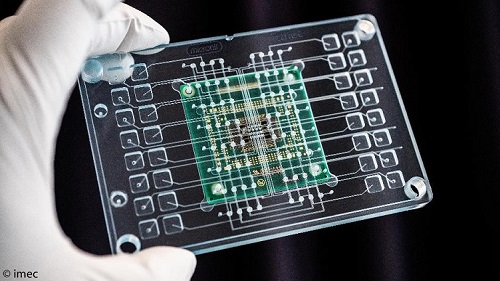 The chip is patterned with microstructures to allow for structure cell growth mimicking specific organs. Source: Imec
Research house Imec has demonstrated an organ-on-chip platform designed to work with pharmacological studies merging a high-density multi-electrode array (MEA)-chip with a microfluidic well plate where cells can be cultured, providing an environment that mimics human physiology.
The device offers the health-care industry a way to garner quality data in the drug development process by performing multiple tests in parallel.
Imec said it developed the platform to address the thousands of candidate drugs that don’t make it to commercialization because development is time-consuming, costly and insufficient for existing methodologies of drug screening assays.
The organ-on-chip packs 16,384 electrodes, distributed over 16 wells and offers multiparametric analysis. Each of the 1,024 electrodes in a well can detect intracellular action potentials. The chip is patterned with microstructures to allow for structure cell growth mimicking a specific organ.
“By using grooves, heart cells can, for example, grow into a more heart-like tissue. In this way, we fabricate miniature hearts-on-a-chip, making it possible to test the effect of drugs in a more biologically relevant context,” said Veerle Reumers, researcher at Imec involved in the development of the chip. “Imec’s organ-on-chip platform is the first system that enables on-chip multi-well assays, which means that you can perform different experiments or — in other words — analyze different compounds, in parallel on a single chip. This is a considerable increase in throughput compared to current single-well MEAs and we aim to further increase the throughput by adding more wells in a system.”
Imec is demonstrating the organ-on-chip at this week’s Imec Technology Forum in Antwerp, Belgium. To learn more about the conference, click here.