Accelerator Upgrades Expand Astrophysics Research
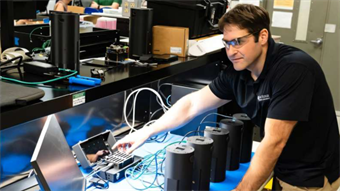
Tony Pallone | August 07, 2018 Proton beam inside the ECRIS acceleration column. Source: Arthur E. Champagne
For astrophysicists wanting to study the nuclear reactions that form stars — reactions that are often accompanied by huge amounts of energy, sometimes over billions of years — a low-energy laboratory setting presents a major stumbling block.
But after six years of upgrades to the Laboratory for Experimental Nuclear Astrophysics (LENA), researchers from the University of North Carolina (UNC) are seeing unprecedented levels of accelerator performance. In a new report, they note improvements to the system’s acceleration column and microwave system that make the system safer, yielding better high-voltage source stability and signal-to-background ratio.
LENA’s electron cyclotron resonance ion source (ECRIS) accelerator was in need of an overhaul: pushing it to its limits caused overheating, melting the glue between joints and creating a vacuum problem that allowed harmful radiation to escape during experiments. The upgrades, which began in 2012, included incorporating a compression design and O-ring seals to ensure an adequate vacuum, along with installing measures to cool the system and prevent radiation from forming.
"What a lot of people don't realize is that there isn't really anything that exists on the market for this that we can just buy," said Andrew Cooper, one of the lead designers behind the project. "We approached it as a challenge."
Enhanced optics have also allowed the system to set a new record for non-damaging proton beam intensity — an order-of-magnitude increase in normalized brightness, which is exactly the sort of upgrade astrophysicists need to study star-forming phenomena. In addition, the new system is more resilient to environmental background interference from sources such as space radiation.
Cooper and his colleagues next seek to further explore features of the system in order to increase target beam intensity, aiming to increase it to 10 milliamps from its current 3.5 milliamps.
Their upgrade report appears in the Aug. 7 edition of Review of Scientific Instruments.