New light-controlled microgripper delivers both accuracy and force
Marie Donlon | July 16, 2026Researchers at Anhui University in China have developed a miniature mechanical gripper that is controlled by light signals via an optical fiber.
Optical tweezers have long been used to manipulate tiny objects with precision, oftentimes using carefully controlled beams of laser light. However, until now, this approach is limited in terms of how much force it can exert.
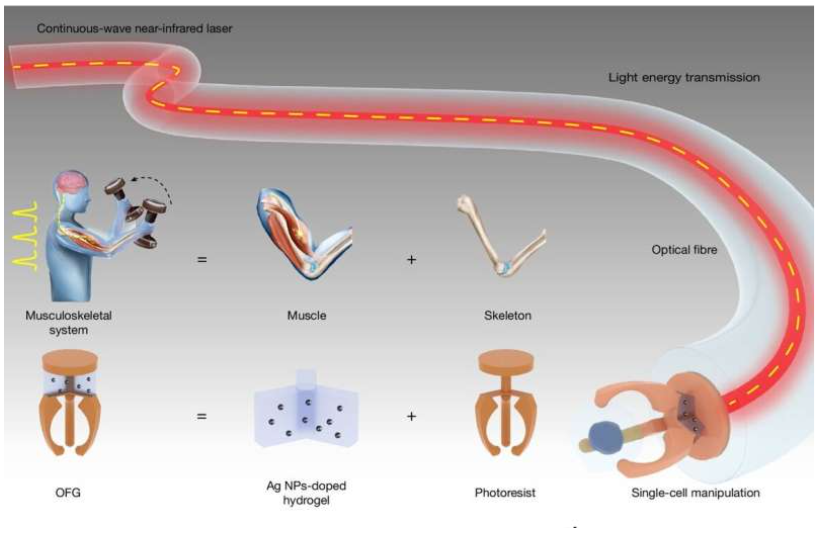 Source: Nature (2026). DOI: 10.1038/s41586-026-10673-7
As such, the Anhui team attempted to improve upon this design with its miniature mechanical gripper, which can be controlled by light signals using an optical fiber.
By combining the precision of light-based tools with the gripping strength of mechanical devices, the gripper promises to improve the ease with which researchers can manipulate and assemble objects at the microscale.
Optical tweezers use a focused laser beam to trap and manipulate tiny objects without physical contact, thus enabling precise control of individual molecules and cells. However, because they produce extremely small forces, they are typically limited to handling small, transparent and regularly shaped objects, while larger, opaque or irregularly shaped items are difficult to trap reliably.
Consequently, the team constructed a 3D optical fiber gripper (OFG) that measures just 38 μm × 38 μm × 61 μm — which is small enough to fit inside a human hair. The device was directly fabricated onto the tip of a commercial optical fiber through a technique called two-photon polymerization, which is a type of 3D printing that works at microscopic scales.
The team explained that an optical fiber within the device functions as a nerve, transmitting light signals. Meanwhile a hydrogel embedded with silver nanoparticles functions as a muscle and rigid polymer claws make up the skeleton. As near-infrared laser light travels through the fiber and then strikes the nanoparticles, it heats the hydrogel, thereby causing it to contract and subsequently open the claws. By switching off the light, the claws will close again, grasping whatever lies between them.
During trials, the gripper responded in 77 milliseconds and could potentially open and close up to five times per second. Additionally, its force output could potentially be measured in micronewtons, this is more than 10 times higher than previous fiber-based tweezers.
The device also handled objects ranging from alumina spheres and silicon carbide fragments to copper wires 8 inches long. Likewise, the gripper also grasped, transported and released individual human cancer cells without damaging them and assembled miniature mechanical components, such as bearings and gearboxes, all with micrometer precision.
The OFG can also reach places conventional grippers cannot, such as channels narrower than 300 μm as well as excised animal tissue. Possible applications for this gripper might eventually grow to include single-cell biology, minimally invasive surgery and the construction of microscale machines.
An article detailing the gripper, “Optical fibre gripper for high-performance 3D micromanipulation,” appears in the journal Nature.