
Understanding pH slope
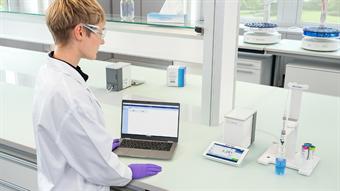
Neha Shinde, courtesy of Mettler Toledo | July 18, 2026 Figure 1: pH Sensor Calibration. Source: Mettler Toledo
The pH slope is like the heartbeat of your sensor — a fundamental indicator of electrode health and measurement reliability during calibration. Steady and precise, it is vital for translating chemistry into clarity. This article highlights the critical role of the pH slope in potentiometric measurements, explaining how it defines electrode potential changes relative to hydrogen ion activity, and why understanding this parameter is essential for accurate pH analysis.
pH sensor calibration
pH sensors can drift over time due to various factors such as electrode aging, changes in the chemical environment and contamination. To maintain accurate and reliable measurements, calibration is necessary. Calibration involves adjusting the pH sensor using buffer solutions with known pH values, ensuring that the readings are traceable and precise. Typically, this process is performed by measuring the sensor's response to standard buffer solutions, usually at pH 4, 7 and 9.21 or 10, and then adjusting the sensor output accordingly. Since pH electrodes can experience drift, it is important to calibrate them regularly — ideally, at least once a day before starting measurements. During calibration, the electrode's slope and offset are determined to correct its response.
The theoretical slope and offset are values determined by the Nernst equation:
 Equation 1. Electrode potential, slope and offset for a pH electrode.
(Applicable for any temperature)
Slope = 2.3RT / nF
Offset = Should be 0 mV at pH 7.00
Where, E is the measured electrode potential, E0 is the standard electrode potential/constant, R is the gas constant, T the absolute temperature in Kelvin, n the number of electrons transferred (which is 1 for hydrogen ions) (ionic charge), F the Faraday constant and aH+ is the hydrogen ion activity.
Calibration is necessary to adjust the slope and offset of an electrode to their true values for the measuring system in question. The calibration curve is then used to correlate the measured mV values of the electrode to the pH value of the solution measured.
What is pH slope?
The pH slope refers to the response characteristic of a pH electrode or sensor, indicating how the electrode potential changes with respect to changes in the pH of the solution being measured. In simpler terms, it reflects how sensitive the electrode is to changes in hydrogen ion concentration.
From equation 1, the pH slope emerges as the voltage change per unit change in pH, reflecting the electrode's sensitivity. At the standard temperature of 25º C, the theoretical slope is approximately 59.16 millivolts (mV) per pH unit change. This value is derived by simplifying the Nernst equation under regulated conditions and reflects the ideal sensitivity of a perfectly functioning electrode. It means for every unit change in pH, the measured potential changes by about 59 mV.
Mathematically, the pH slope (S) is represented as:
 Equation 2. Slope for a pH electrode.
Where, E1 and E2 are the electrode potentials at pH values pH1 and pH2 respectively.
Let's visualize the pH slope concept using practical samples. Since pH calibration is commonly performed using standard buffer solutions at pH 4, 7 and 10, we will use these buffers. In this case, a 3-point segmented calibration is applied, allowing us to obtain two separate calibration curves for the ranges 4–7 and 7–10, each with its own slope. This approach more accurately reflects the actual response behavior of pH electrodes.
In this simplified example: The electrode potentials measured for standard buffer solutions at pH 4, 7 and 10 are 177 mV, 0 mV, and -177 mV, respectively, demonstrating the expected linear response of the pH electrode across these calibration points.
- The potential difference between pH 4 and pH 7 is 177 mV
- The potential difference between pH 7 and pH 10 is also 177 mV
Calculating the slope:

This confirms the ideal Nernstian response. This shows the sensor is healthy.
But what if the pH slope is not 59 mV/pH units at 25º C? The slope of the calibration curve should be about 59 mV/pH units at 25º C. However, the actual response is often quoted as a percentage, and a good calibration should lie between (at least) 85% and (at most) 102% of the theoretical value in mV.
Slope percentage calculation formula:
 Equation 3. Slope percentage for a pH electrode.
In practical applications, the measured pH slope often deviates from the theoretical ideal due to several factors. Electrode aging, contamination, damaged or fouled membranes, ionic strength variations and calibration errors all lead to reduced or altered slopes. Such deviations indicate that the electrode is not responding ideally, potentially compromising measurement quality.
Calibration procedures establish a realistic slope that incorporates these real-world effects. Therefore, understanding pH slope fundamentals encompasses:
- Grasping the Nernst equation's role
- Calculating the theoretical slope at given temperatures
- Recognizing the temperature-driven variability of slope values
- Differentiating between ideal and practical electrode responses
This comprehension is foundational for optimizing pH measurement accuracy, calibration strategies and quality control in diverse analytical and industrial contexts.
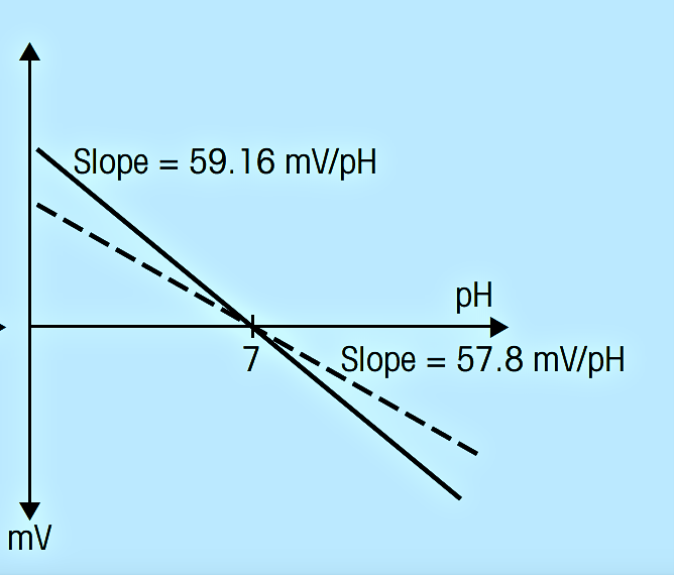 Fig. 2. Slope adjustment of a pH electrode. Solid lines show ideal behavior; dashed lines show real behavior. Source: Mettler ToledoThere are two settings in the pH meters that are adapted to the specific electrode attached to the meter and are affected when the pH electrode and the meter setup are adjusted, namely the zero point offset (mV) and the slope (mV/pH) of the electrode. Since two settings must be adjusted, it follows that a two-point calibration is the minimum adjustment that should be performed. In most cases, depending on the expected measurement range, buffer solutions of pH 4.01 or pH 9.21 (or 10.00) are recommended to adjust the slope. The slope adjustment is illustrated in Figure 2. Here, the deviation from the theoretical 59.16 mV/pH at 25° C is depicted at pH 7.
Temperature dependence
From equation 1: Slope = 2.3RT / nF
We can clearly see that the slope of an electrode is linearly dependent on the temperature. Because this dependence is linear, the behavior is fully predictable and can be automatically compensated for this effect, by a modern pH meter and electrode equipped with an integrated temperature sensor. Use METTLER TOLEDO pH Sensors with Integrated Temperature Probe (NTC 30 kΩ), which are designed for more precise and reliable pH measurements, regardless of temperature fluctuations.
[0° C - 54.2 mV; 25° C - 59.16; 50° C - 64.1 mV]
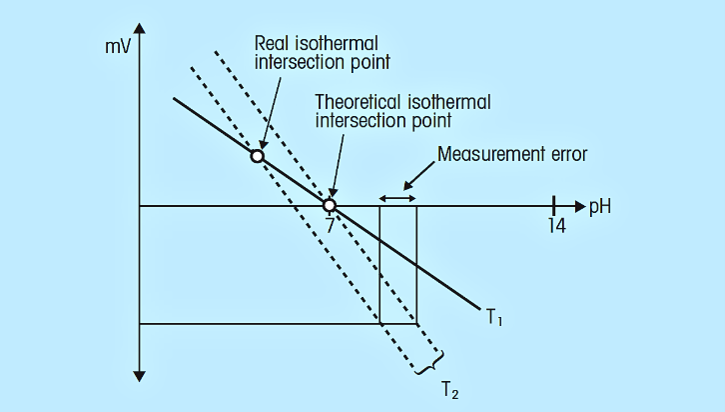 Figure 3: Isothermal intersection, theory and practice. Source: Mettler ToledoHowever, another practical consideration is the isothermal intersection — the point where calibration lines at different temperatures intersect. Ideally, this point coincides with the zero point at pH 7.00 and 0 mV, and the slope would always be proportional to the absolute temperature. In reality, the isothermal intersection may differ due to complex temperature dependencies of individual electrode potentials. When the real isothermal intersection diverges from the theoretical one, measurement errors can increase, especially if there is a temperature difference between calibration and sample solutions. Such errors may be around 0.1 pH units, emphasizing the importance of calibrating and measuring samples at similar temperatures.
Best practices for maintaining optimal pH slope and measurement
Regular calibration
Perform routine calibration using fresh standard buffer solutions (commonly pH 4, 7 and 10) to verify and adjust the electrode’s slope and offset. Employing calibration buffers that closely match sample ionic strength.
Proper electrode storage
Store pH electrodes in appropriate storage solutions when not in use to prevent drying out or contamination, which can degrade the slope.
Clean electrodes regularly
Clean the electrode according to manufacturer recommendations to remove deposits and residues that affect response sensitivity.
Use high-quality buffers
Always use fresh, uncontaminated buffer solutions for calibration to ensure accurate slope determination.
Check electrode condition
Monitor the electrode slope value regularly; a slope significantly below the ideal (around 59 mV/pH at 25° C) indicates the need for maintenance or replacement.
Avoid extreme conditions
Minimize exposure to extreme temperatures, solvents or aggressive chemicals that can damage the electrode membrane and affect the slope.
Temperature compensation
Use automatic temperature compensation features on pH meters to maintain accurate slope readings across varying temperatures.
Proper handling
Handle electrodes carefully to avoid physical damage, which can impair slope performance.
Applications and implications of pH slope variations
The pH slope, a quantitative measure of electrode sensitivity to pH changes, has critical practical implications across multiple fields including pharmaceuticals, environmental monitoring, food analysis and sensor technology. Variations in pH slope not only reflect the operational status of pH electrodes but also profoundly influence the accuracy and reliability of pH measurements, with direct consequences for quality control and regulatory compliance in diverse industries.
In industries such as pharmaceutical and biotech manufacturing, precise pH control is critical for product stability, safety and efficacy. The pH slope, ideally about 59.16 mV/pH at 25° C, indicates electrode responsiveness; deviations suggest electrode issues causing inaccurate readings. Standards require slope values within 85% to 105% of theoretical values, with regular verification and validated calibration to maintain process control.
Environmental water quality assessments similarly depend on accurate pH measurements, where slope variations can affect the characterization of aqueous systems. Fluctuations in slope may arise from electrode fouling. It can also arise from matrix effects, commonly found in natural waters laden with organic matter, heavy metals and varying ionic strengths. pH influences the bioavailability of nutrients and toxic elements, as well as microbial activity. Accurate slope calibration ensures reliable monitoring of aquatic ecosystem health and compliance with environmental standards. Natural waters present complex chemical interactions that affect electrode response. Environmental protocols require rigorous electrode maintenance and calibration to ensure measurement fidelity.
In the realm of sensor development, the pH slope functions as a key performance metric in the design and validation of novel electrochemical sensors. Emerging applications in wearable technology and industrial monitoring increasingly rely on sensors calibrated for optimal slope performance to achieve high sensitivity and selectivity. Deviations in slope during development phases may indicate issues such as membrane instability or sensor drift, guiding iterative refinements. Moreover, achieving stable and near-Nernstian slopes under varying environmental conditions remains a critical benchmark for sensor reliability and reproducibility.
Across industries, like food and beverages, the establishment and enforcement of acceptable pH slope standards are guided by both regulatory agencies and internal quality management systems. While universal theoretical slope values exist, practical acceptance ranges account for inherent instrumental and environmental variability.
In summary, the role of the pH slope transcends mere theoretical interest; it is pivotal to ensuring measurement accuracy and consequently informs critical decisions in product quality, environmental stewardship and sensor innovation. Variations in pH slope require systematic attention through robust calibration, maintenance and adherence to industry-specific acceptance criteria to mitigate risks associated with inaccurate pH readings. This underscores the importance of integrating pH slope analysis into routine quality control and sensor validation workflows across sectors.
For a detailed explanation of linear versus segmented calibration and guidance on which method is best suited for your system and application, please refer to the pH Theory Guide — Mettler Toledo.
To contact the author of this article, email pHmatters@mt.com

Great!A clear and informative explanation of pH slope, and I also enjoy exploring , a site that brings different Geometry Dash versions and experiences together in one place.
In reply to #1
Great explanation of pH slope, and I also enjoy exploring Geometry Vibes.