SLAC now hosts the most powerful X-ray laser
S. Himmelstein | January 15, 2024A recently completed upgrade to the Linac Coherent Light Source (LCLS) X-ray free-electron laser (XFEL) at the U.S. Department of Energy’s SLAC National Accelerator Laboratory successfully produced its first X-rays. Now called the LCLS II, the revamped system at Stanford University has the ability to produce up to a million X-ray flashes per second — 8,000 times more than its predecessor — and is expected to transform exploration of the atomic-scale, ultrafast phenomena key to quantum materials, clean energy technologies and other applications.
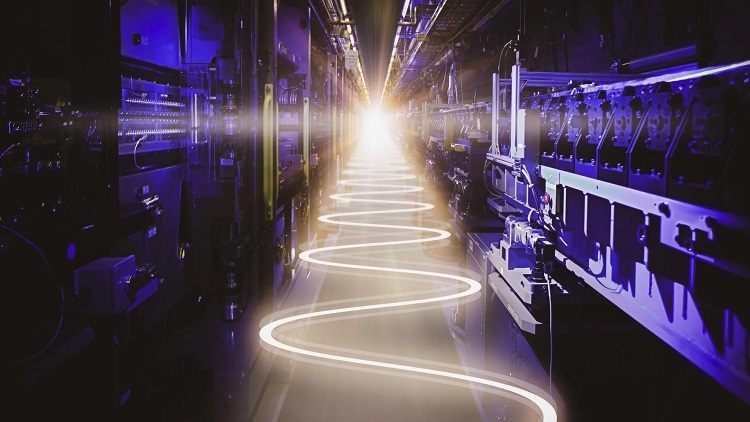 The newly upgraded LCLS II XFEL is the world's most powerful X-ray source. Source: Greg Stewart/SLAC National Accelerator Laboratory
The LCLS II project partners enhanced these capabilities by engineering a revolutionary superconducting accelerator, comprising 37 cryogenic modules that are cooled to -456° F, a temperature at which it can boost electrons to high energies with nearly zero energy loss. The superconducting accelerator fires electrons that travel over a distance of more than two miles during which the “soft” and “hard” X-ray undulators produce X-rays with low and high energy, respectively — allowing researchers to precisely tailor their experiments. These are carried out in experimental hutches where they can capture atomic-scale snapshots of chemical reactions at the attosecond timescale at which electrons move.
Other cutting-edge components include a new electron source, two powerful cryoplants that produce refrigerant for the niobium structures in the cryomodules and two new undulators to generate X-rays from the electron beam. Advances in laser technology, data processing and sensors and detectors also expand XFEL utility and efficiency.
The next planned upgrade will extend the photon energy reach to much shorter wavelengths, allowing greater atomic precision in the measurements.