New Device Boosts Road Time for Tesla, Leaf Drivers
S. Himmelstein | November 23, 2017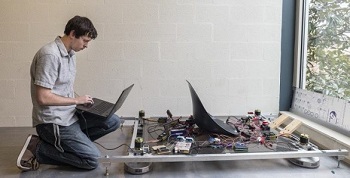 Tim Potteiger, a Ph.D. student in electrical engineering, tests his battery-switching device on a levitating electric vehicle in the School of Engineering. Source: Joe Howell/Vanderbilt UniversityA Nissan Leaf can travel about 107 miles on a charge, while the standard Tesla Model 3 can double that distance. These may be viewed as progress in electric vehicle (EV) technology but both induce range anxiety in drivers.
A solution devised at Vanderbilt University could enable both batteries to operate about 50 percent longer. The idea is to reconfigure modules in EV battery packs to be online or offline — depending on whether they’re going to pull down the other modules.
The researchers used Tesla’s open-source, high-density, lithium-ion battery to model their method of improving durability, adding a controller to each of the battery’s cells.
“We know there are some battery cells that run out of juice earlier than others, and when they do, the others run less efficiently,” said Tim Potteiger, a Ph.D. student in electrical engineering. “We make sure they all run out of energy at the same time, and there’s none left over.”
In the current configuration of Tesla and Nissan battery packs, gauges give a worst-case scenario on the amount of power left so that users don’t get stranded. That means they commonly show empty with 10 percent or more power left. A more accurate read is also provided by the new device, allowing drivers to get the most out of a charge. A longer battery service life is another benefit.
The device is the result of lessons learned from building a levitating one-seat vehicle and information gleaned by Potteiger during a NASA internship. The class constructed a working, one-seat vehicle that uses magnets to levitate a few inches over an aluminum track, but batteries that drained too quickly proved a major challenge.
Potteiger applied what he learned in real-time prognostics at NASA to solving the problem together with Ken Pence, professor of the practice of engineering management. The team developed the battery switcher and is working with Vanderbilt Center for Technology Transfer and Commercialization to get it to market.