
No More Stopping at Red Lights
Abe Michelen | June 23, 2017If you are not happy when you have to stop at a red light, hang in there. Help is coming. A group of researchers at Singapore’s Agency for Science, Technology and Research (A*STAR) have developed a driving aid that is being installed in some test cars.
 City traffic can flow more freely without the inefficient stop-start interference of traffic lights. (Source: A*STAR)
The idea behind this system is similar to the token ring network topology, an efficient and fast network protocol. When a test car reaches an intersection without red lights, it crosses it in its own “safe space,” controlling its speed using adaptive cruise control.
According to Bo Yang, from the A*STAR Institute of High Performance Computing, who led the work, in the future, to help the path of the vehicles, intersections will have a communication beacon – similar to a GPS satellite – that will replace traffic lights. This instrument will collect, analyze and transmit data about the vehicles approaching the intersection, including their approaching speed and distance from the intersection and other vehicles. Each vehicle approaching the intersection will collect this data, and using a computer algorithm, each car will plot the safest course it should follow without stopping.
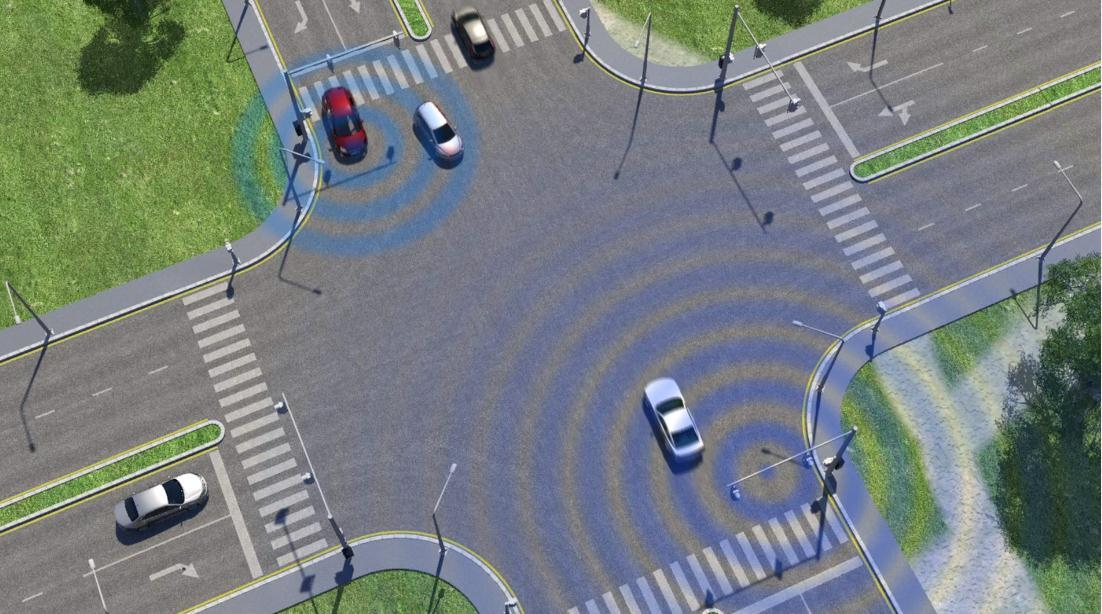 A smart intersection with communication beacons. (Source: A*STAR)
The algorithm uses the concept of “adaptive repulsive force,” in which a repulsion between two approaching cars is inversely proportional to the distance between each other. The stronger the repulsion force, the greater the speed adjustment the cars will make so they can pass each other safely.
“One of our most interesting findings is that the rules governing the necessary repulsion between vehicles is rather simple,” Yang said. “The result is a system that does not require much computing power at the beacon or in the vehicle itself,” he adds.
For this system to work, cars should be able to break and accelerate autonomously – activities that today are a reality in cars with smart cruise control; they don't necessarily need to be fully self-driving. At the intersection, the driver gives control of the speed to the car computer, but retains the steering control. In tests, the algorithm worked very efficiently even for very complex intersections. “In most cases, pre-emptive deceleration only slightly lowered the vehicle velocity, resulting in safe passage of each vehicle across the intersection without coming to a full stop at any point,” Yang said.
If adopted, the system would have to be phased out slowly to help older cars pass smoothly through the intersections. As more and more smart vehicles populate our streets, traffic lights could be eliminated slowly until they are no longer needed.
“Our simple algorithm only requires basic vehicle intelligence, but is also fully compatible with more intelligent vehicles that may come in the future,” Yang noted.
The result of Yang’s team work was published by ScienceDirect. An abstract can be found on their site.


Today the world has the ability to transport people and freight without the need of humans.
Many of our Military aircraft have been retrofitted with instrumentation which transforms planes and helicopters to near fully autonomous craft. The majority of aircraft today are equipped with computers capable of landing airplanes without human control especially during times of limited visibility. Most of the worlds passenger planes are also being equipped with devices that communicate with each other providing information about their location, altitude, speed, and direction. This information is used to help pilots avoid in air collisions can easily be used to allow the fitting of aircraft to travel autonomously without human control.
Google and other companies along with government have mapped nearly every known inch of the planet we call home. With a few strokes of destination entry, a map with the least time route appears on our cellular phones and many of our vehicles.
We are also building automobiles with equipment similar to what is installed in aircraft. Many of today's cars can, without a major redesign, easily be converted to fully autonomous. Only a destination needs to be provided for those autos to safely carry passengers without a person behind the wheel. In summary, the world is already at the point where autonomous travel is possible with little modification to vehicles we have now. The only thing people will need to know is where they are going, when they want to arrive, the amount room required for travel, and a time when they must be ready to begin their trip.
Waiting for mankind to accept the reality of how advanced we are is our biggest obstacle. When people accept what is already understood and the government allows these specialized vehicles on our land, air and seas the technology will advance further and more rapidly than it is today. This enhanced move toward a more intelligent autonomy will offer more advanced planning, safety, and navigation. In short, we are waiting on mankind to give the government the green light to set the guidelines and change the laws to make these things available.
When I look ahead I see no need for humans driving any vehicle on our roadways, seas, or airways. We will realize a massive improvement in safety resulting from the removal of humans inherent error of judgment. In the beginning, humans will serve on conveyances as a backup to the new and redundant automation systems only as a precautionary measure while the population acclimates to our new autonomous world. Not long after this, the need for human intervention of all kinds will be entirely eliminated. Much of the cost of developing and installing devices to accommodate our autonomy will be largely recovered from savings realized by removing humans from the operation of our conveyances.
Once we take advantage of our present-day capabilities the world will begin a phase where personal ownership of transportation will begin a more rapid advance to shared transportation vehicles. They will carry everything from people to retail goods. The overly tired long haul drivers will no longer unsafely be on our roads. Drunk driving will be a thing of the past and a vehicle needed for an emergency can be any vehicle as it takes precedence over all other traffic without the need for wailing sirens. Shared vehicles will be used to carry one person or several people to the same destination or multiples which are near others much like ride sharing today. Nearly 100% of our traffic signals and signs will be removed leaving our country less littered along all the transportation byways. Predicting arrival times will be simpler than ever before.
The time when we can forget the road rage and instead settle back relaxing to a good movie or using the extra time to get work done allowing an early finish our day job can lead to more family time. Roadways will start to be eliminated reducing noise, congestion, and pollution once our travel shifts to small airborne methods of intercity and town to town travel.
We have a great new world in our very near future, a world that will begin a return to many of the creations of nature than those of men. All of this because we accepted our knowledge and skills to develop and produce automated transportation of the future.