Tweaking traffic lights during snowstorms can ease snarls
David Wagman | March 05, 2019Cities could ease congestion and improve safety during snowstorms by adjusting traffic light timing to take road conditions into account.
Researchers at the University of Waterloo collected data and ran computer simulations to determine that adjusting the signals at intersections in bad weather could reduce delays by up to 20%.
Traffic signals typically are timed using optimization models that analyze factors including traffic volume and speed to safely get as many vehicles as possible through intersections. One problem is that those parameters assume normal weather conditions. In a snowstorm, the researchers said, if the road surface is covered with snow and ice and visibility is poor, the numbers are not the same.
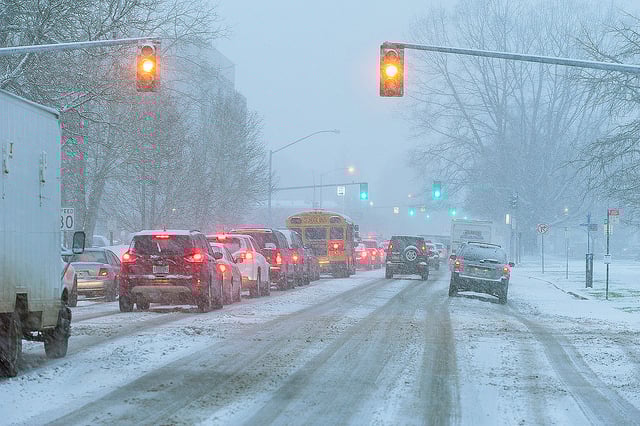 Adjusting traffic signal timing during a snowstorm can ease snarls. Source: Oregon Dept. of TransportationResearchers analyzed hours of video taken at an intersection near the Waterloo campus to measure how drivers change their driving during snowstorms in terms of speed, stopping distance and other variables.
That data was then used in computer simulations to optimize signal timing at an intersection and on a stretch of road with four coordinated intersections.
Changes were also made to improve safety, such as increasing the yellow interval to account for slower vehicles that require more time to stop.
At the single intersection, researchers found that changes to increase safety and reduce delays almost canceled each other out. But even with adjustments to help avoid crashes, intersection delays in the coordinated corridor, especially in moderate traffic, decreased by up to 20%.
The researchers said that cities with computerized signal systems are already equipped to remotely adjust traffic light timing when snowstorms hit.
Next steps for the researchers include developing technology using video cameras and artificial intelligence software to automatically adjust traffic light timing. One future goal is to develop signal controls that are so smart that they change themselves in real time based on what is happening in the road network.