Protecting Autonomous Vehicles from Cyberattack
Marie Donlon | May 24, 2017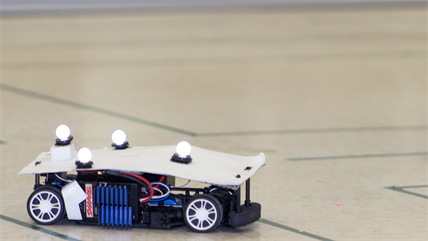 (Source: Texas A&M University)As vehicles become more and more autonomous — internet-enabled, self-driving — their vulnerability to cyberattacks becomes greater and greater. As a result, Texas A&M University researchers have created an intelligent transportation system prototype to prevent collisions and to help thwart autonomous vehicle hacking attempts.
Because autonomous vehicles rely on sensors to automatically control them, the concern is that hackers will gain control of the sensors and cause accidents and confusion. Similarly, internet-enabled vehicles are also increasing the potential for cyberattacks on the vehicle.
Unfortunately, considering that an autonomous vehicle is simply a large computer on wheels, securing it requires more than securing a computer.
In search of a solution, Dr. P.R.Kumar, University Distinguished Professor in the Department of Electrical and Computer Engineering, along with graduate students Bharadwaj Satchidanandan and Woo-Hyun Ko, are applying the theory of dynamic watermarking of sensors in autonomous vehicles to prevent cyberattacks.
Researchers assembled 10 cameras to record the movement of the self-driving prototype vehicles. The vision sensors in the system received the images and determined the exact location and orientation of the vehicles. They then communicated this information to a server, allowing it to control the vehicle.
"Sensors are like GPS navigation in the network that gather information about the environment," said Satchidanandan. "Actuators such as motors, or controls such as the steering wheel, interact with them. If the sensors are corrupted or hijacked by malicious agents through the internet, they can provide false information on vehicle locations resulting in collisions."
To remedy this, Kumar and his team added a random private signal called a 'watermark' to the actuators. The watermark and its statistical properties were known to every node in the system, but its actual random values were not revealed. When the measurements reported by the sensors did not have the right properties of this watermark, the actuators concluded that the sensors or their measurements had been tampered with at some point. Equipped with this information, the researchers could predict a collision.
In the lab, realizing that the sensors had been tampered with, the autonomous vehicles halted themselves.
"This is an instance of the broader concern of security of cyberphysical systems. The increasing integration of critical physical infrastructures, such as the smart grid or automated transportation, with the cyber system of the internet has led to such vulnerabilities," said Kumar. "If these technologies are to be adopted by society, they will need to be protected against malicious attacks on sensors."