Biosensor Monitors, Regulates Bloodstream Drug Levels
S. Himmelstein | May 16, 2017Administering the correct dose of life-saving drugs, such as insulin or chemotherapy agents, is a challenge because of individual variability in tolerance to and metabolism of pharmaceuticals. A drug delivery tool that promises to provide accurate dosing was developed by Stanford University, California, researchers, who demonstrated that the technology could continuously regulate the level of a chemotherapy drug in animals.
In the new device, a real-time biosensor continuously monitors drug levels in the bloodstream as a control system calculates the right dose. A programmable pump delivers just enough medicine to maintain a desired dose.
The sensor contains aptamers, molecules specially designed to bind a drug of interest. When the drug is present in the bloodstream, the aptamer changes shape in an action detected by an electric sensor. The more drug present, the more aptamers change shape. The data are captured every few seconds and routed through software that controls the pump to deliver additional drugs as needed.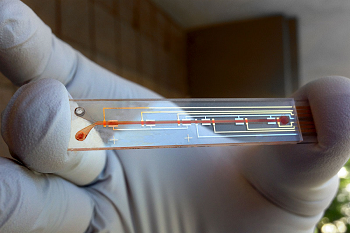 A prototype of the biosensor designed to detect active levels of a medicine in the bloodstream as part of a system to personalize drug dosing. (Image credit: Soh Lab, Stanford University))
The researchers tested the closed-loop system by administering the chemotherapy drug doxorubicin in animals. Despite physiological and metabolic differences among individual animals, they were able to keep a constant dosage among all the animals in the study group, something not possible with current drug delivery methods. The team also tested for acute drug-drug interactions, deliberately introducing a second drug that is known to cause wide swings in chemotherapy drug levels. Again they found that their system could stabilize drug levels to moderate what might otherwise be a dangerous spike or dip.
Many years of tests lie ahead to ensure that this technology is safe and effective for people, but the researchers believe it may be big step toward personalized medicine. The device could be especially helpful for pediatric cancer patients, who are notoriously difficult to dose because children’s metabolism is usually different from adults.
The team plans to miniaturize the system so that it can be implanted or worn by the patient. At present the technology is an external apparatus, like a smart IV drip. The biosensor is a device about the size of a microscope slide. The current setup might be suitable for a chemotherapy drug, but not for continual use. The group is also adapting this system with different aptamers so that it can sense and regulate the levels of other biomolecules in the body.