3D-printed nano-implants target tumors with precise drug delivery
Marie Donlon | April 08, 2026Researchers at the University of Mississippi (Ole Miss) are packaging cancer drug therapies into a 3D-printed hydrogel-based drug delivery system that promises to deliver medication directly to tumors while simultaneously reducing the many side effects endured by cancer patients.
According to its developers, these so-called 3D-printed spanlastics — which are microscopic carriers loaded with anti-cancer drugs — are implanted at tumor sites to target and destroy cancer cells.
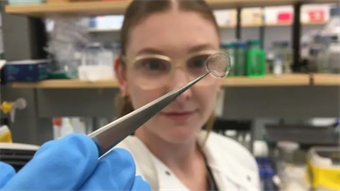
 Source: Hunt Mercier/Ole Miss Digital Imaging Services
"This paper introduced a new 3D printing concept called FRESH [freeform reversible embedding of suspended hydrogels] 3D printing," the researchers explained. "It uses spanlastics as a new nano-drug delivery vehicle for anticancer drug delivery. We actually applied this on breast cancer cells and we got some really, really promising data."
The team explained that traditional chemotherapy is typically given orally or injected into the bloodstream where the circulatory system disperses the cancer-fighting therapy throughout the body, targeting cells that reproduce quickly, like cancer. However, they also target other quick-spreading cells like hair, intestinal linings and skin, which is one of the reasons that chemotherapy has so many side effects, like hair loss, nausea, vomiting and anemia.
As such, the team suggested that delivering the drug directly to the cancer cell might minimize those side effects.
Because the capsules are between 200 nm and 300 nm long and capable of passing through cell membranes, they could potentially deliver a high dosage of cancer-fighting medication precisely to those affected cells.
As every cancer drug needs to act inside the cell, either on RNA or on DNA or inhibiting a cell pathway, if the drug cannot penetrate the cell membrane or cannot be taken up by the cell, it is ineffective.
However, when that drug is put in a nanoparticle, the drug is protected from degradation, so that a decent amount of drug molecules is pushed into the cell in one shot, the researchers explained.
The team suggests that because this approach focuses on a single area, it could prove beneficial particularly in early cancer diagnoses, before the disease spreads.
"With this study, we did two things: One is using 3D printing as a fabricating method for a hydrogel-based drug delivery system. The second one is we demonstrated these drug delivery systems can be effective in killing cancer cells in vitro, but there is still a long way to go," the team cautioned.
An article detailing the work, “Fresh 3D Printing of Spanlastics Hydrogel for Drug Delivery Applications In Vitro,” appears in the journal Pharmaceutical Research.