Graphene Helps Harvest Stem Cells for Nerve Regrowth
S. Himmelstein | April 11, 2017The myriad uses of graphene now include promotion of nerve regeneration. Researchers at Iowa State University developed a nanotechnology that uses inkjet printers to print multi-layer graphene circuits to affect differentiation of mesenchymal stem cells into Schwann cells.
Essential for nerve cell health and function, Schwann cells are useful tools in regeneration research. The accepted chemical process for transforming mesenchymal stem cells into Schwann cells is time-consuming and costly. The graphene circuits, combined with lasers to treat and modify their surface structure and conductivity, offer a more effective approach.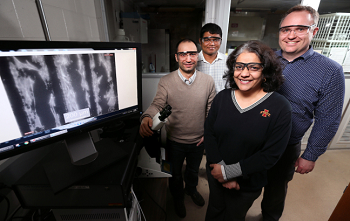 Iowa State University researchers, left to right, Metin Uz, Suprem Das, Surya Mallapragada and Jonathan Claussen are developing technologies to promote nerve regrowth. The monitor shows mesenchymal stem cells (white) aligned along graphene circuits (black). Image credit: Christopher Gannon
Mesenchymal stem cells adhere and grow well on the treated circuit’s raised, rough and 3-D nanostructures. After treatment with 100 millivolts of electricity for 10 minutes per day over 15 days, the stem cells become Schwann-like cells.
The electrical stimulation differentiates 85 percent of the stem cells into Schwann-like cells compared to 75 percent by the standard chemical process. Electrically differentiated cells also produced 80 ng/ml of nerve growth factor compared to 55 ng/ml for the chemically treated cells.
The graphene inkjet printing process is the key to creating a low maintenance, artificial framework for neural damage repairs. The computer-controlled laser technology developed by the researchers selectively irradiates the printed graphene oxide to remove ink binders and reduce the material to graphene—physically stitching together millions of tiny graphene flakes. The process makes electrical conductivity more than a thousand times better.
The technology might one day be used to create dissolvable or absorbable nerve regeneration materials that could be surgically placed in a person’s body and wouldn’t require a second surgery to remove.