Watch: Mass Production of Microscale Robots
S. Himmelstein | October 25, 2018A new manufacturing process bodes well for developing microscopic robots that swim through the bloodstream to detect disease or traverse pipelines to monitor structural integrity. MIT researchers have 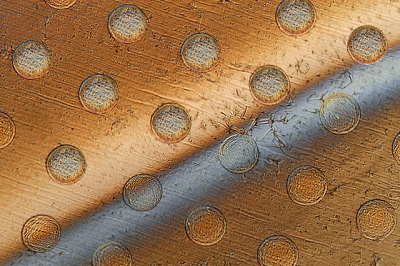 Circles appear on a graphene sheet where the sheet is draped over an array of round posts, creating stresses that will cause these discs to separate from the sheet. The gray bar across the sheet is liquid being used to lift the discs from the surface. Source: Felice Frankelengineered an auto-perforation method for mass-producing cell-sized robots.
The technique exploits the natural fracturing properties of graphene to control shapes at the nano scale and yields synthetic cells, or syncells. Graphene layers encase polymer material dots that contain the required electronics deposited by an inkjet printer.
The chemical vapor-deposited 2D sheets auto-perforate into circular envelopes when sandwiching a microprinted polymer composite disc of nanoparticle ink, allowing liftoff into a solution and simultaneous assembly. Lines of high strain form where the graphene overlays the polymer dots, causing the graphene to fracture around the latter and form discs housing the polymer.
The single-step method for large-scale production of syncells with integrated electronics is also applicable to molybdenum disulfide and other 2D materials. The letters M, I and T were inscribed into a syncell’s memory array as a technology demonstration. The array records data as varying levels of electrical conductivity, which can be decoded with an electrical probe.