Robots Scan for Building Defects
John Simpson | September 29, 2016New buildings in Singapore may soon have a robotic inspector rolling up to their doorsteps to look for cracks and other defects.
QuicaBot—developed by scientists from Nanyang Technological University (NTU), JTC Corp. and CtrlWorks—can move autonomously to scan a room in about half the time taken for manual inspection. The robot uses cameras and laser scanners to uncover building defects. The robot can upload 3-D data of the scans to the cloud and inform the human operator, who can then inspect suspected defects.
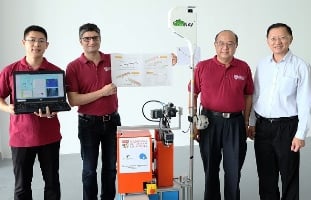 NTU Assistant Professor Erdal Kayacan (second from left), NTU Robotic Research Center Director Chen I-Ming (second from right) and JTC Technical Services Division Director Koh Chwee (right) stand with QuicaBot. Image credit: NTU“Visual inspection of a new building is an intensive effort that takes two inspectors. So we have designed a robot to assist a human inspector to do his job in about half the time, saving precious time and manpower, and with great accuracy and consistency,” says project leader Assistant Professor Erdal Kayacan, from NTU’s School of Mechanical and Aerospace Engineering.
The robot, which can operate for three days on two hours of charging, uses a number of tools, including:
- Small laser scanner for navigation and mapping
- Large laser scanner to inspect wall evenness and squareness
- Inclinometer to check evenness of the floor
- Thermal infrared camera to check for hollowness in tiles
- Small standard color camera to detect cracks on walls
Professor Chen I-Ming, director of NTU's Robotic Research Center and co-leader of the project, says QuicaBot has already done well in simulated environments to assess the interior architectural defects of a building according to existing industry standards. For the next phase of development, the robot will be tested more extensively at suitable locations within one or more of JTC’s industrial developments.