Device Enhances Surgeons' Hand Sensitivity
John Simpson | August 16, 2016A small vibrating device added to surgical tools could improve doctors’ ability to sense different shapes and textures inside their patients’ bodies. Engineers from Hiroshima University have designed the small vibrating mechanism to attach to any existing hand-held surgical tool without requiring extra training for doctors.
During minimally invasive surgeries, surgeons rely on long, thin metal tools to explore their patients’ bodies. Such laparoscopic surgeries benefit patients by reducing the size of surgical cuts and minimizing scarring, but they prevent surgeons from using their fingers to directly touch patients to sense essential information about their organs.
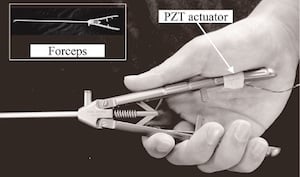 The PZT Actuator attaches to a surgical tool and vibrates in the doctor’s palm at a constant rate. Image credit: Yuichi Kurita, Hiroshima University.The PZT Actuator attaches to a surgical tool and vibrates in the doctor’s palm at a constant rate. The vibrations are so subtle they cannot be sensed. However, this constant, uniform vibration enhances the surgeon’s feel for other, irregular sensations.
To test the device, volunteers were blindfolded and asked to use surgical forceps with the PZT Actuator attached to the handle to identify different textures of sandpaper and find a small Styrofoam ball inside a cup filled with silicone. The experiment was designed to mimic detecting tissue texture and identifying a solid tumor.
The results of these tests and other analysis revealed that there is a range of vibration intensity that significantly improves anyone’s sensitivity. Moreover, the tool does not need to be fine-tuned to each user’s unique sense of touch.
The researchers say the actuator is safe for patients because the device is only on the handles of the surgeon’s tools, not inside the patient’s body. The vibrations are so subtle that they do not shake the tool.
"Our next set of experiments will confirm the usefulness of the PZT Actuator in surgical situations," says Yuichi Kurita, associate professor at Hiroshima University and lead researcher. "Before we can give this tool to surgeons, we must also develop a method to maintain good hygiene of the device so it is always safe for patients,” he adds.