New horizons in surgical robotics
Jody Dascalu | April 25, 2025The field of surgical robotics is advancing rapidly, bringing profound changes to the practice of modern medicine. With the increasing demand for minimally invasive surgeries, robotic technologies have become indispensable tools, enhancing precision, improving patient outcomes and reducing recovery times. As these technologies evolve, clinicians and researchers are working in tandem to push the boundaries of what robotic-assisted procedures can accomplish. From miniaturized platforms to artificial intelligence (AI)-powered automation, the following sections explore three groundbreaking advancements poised to reshape the surgical landscape.
Miniature and flexible robotic platforms
The push for ever-smaller and more adaptable surgical robots arises from the need to navigate intricate anatomical passages with minimal tissue damage. These miniature, flexible systems — often described as flexible surgical and interventional robots (FSIRs) — fit naturally through narrow lumens or tiny incisions, making it easier to reach challenging sites deep within the body. Recent reviews on FSIRs highlight how design advances, such as miniaturized actuators, soft materials and bendable structures, can significantly improve patient outcomes by reducing bleeding, scarring and overall trauma. Machine learning methods have further enhanced these platforms through data-driven modeling, shape sensing and semi-autonomous control, enabling more precise movement while alleviating operator fatigue.
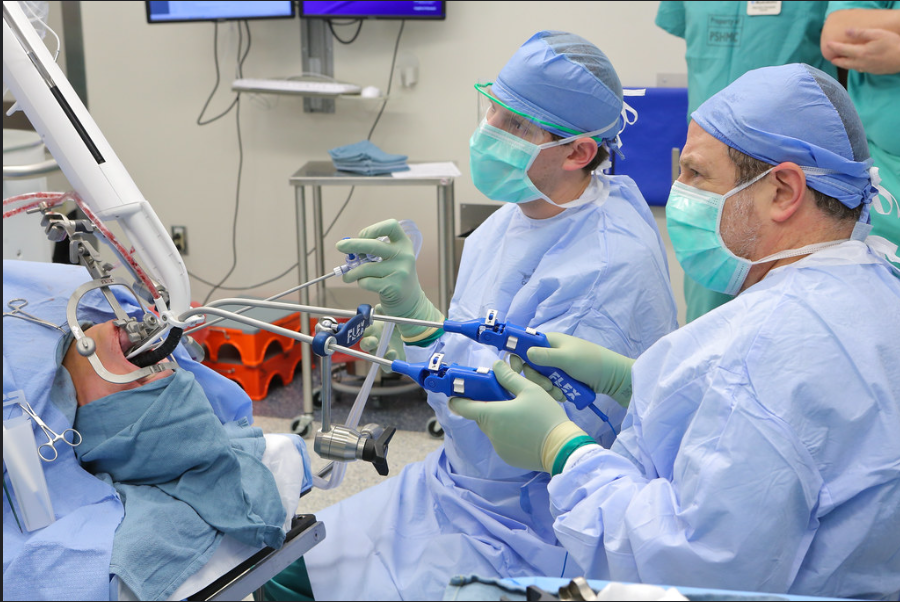 Surgery with flex robotic system. Source: Penn State Health/flickr
- Snake-like robots: Engineered with tendon-driven mechanisms or flexible backbones, these slender robots can thread through winding corridors in the brain, gastrointestinal tract or other constricted spaces. Their ability to mimic natural bending patterns is crucial for minimizing any collisions with delicate tissues.
- Swarm robotics for surgery: Inspired by biological organisms, micro-robotic swarms capable of working collectively inside the body are in development. These tiny robots can perform tasks such as targeted drug delivery, microsurgery and tissue repair with unparalleled precision.
- Modular platforms: Surgeons benefit from robots that can be tailored for different procedures, with swappable modules for tasks like cutting, suturing or imaging. Modular FSIRs also make it easier to maintain and upgrade individual parts as technology evolves.
AI-driven autonomous surgical assistants
Autonomous surgical platforms employ AI algorithms, including deep learning and computer vision, to undertake a range of procedures with minimal human oversight. Although many systems remain experimental, several have already achieved clinical application in tasks such as soft tissue suturing, orthopedic drilling and even automated blood sampling. By harnessing large data sets and continuously refining algorithms, these platforms are increasingly adept at handling patient-specific variations and responding to intraoperative changes in real time.
Despite promising evidence that autonomous robots can match or even surpass expert-level performance in narrowly defined tasks, widespread adoption faces limitations. Complex procedures on deformable tissues challenge current perception and decision-making capabilities and legal frameworks have yet to fully address liability issues. Surgeons continue to play an essential role, as these AI-driven systems are designed to complement — not replace — human expertise. By providing consistent precision and relieving repetitive tasks, autonomous surgical assistants allow clinicians to focus on nuanced aspects of patient care and overall surgical strategy.
- Autonomous soft-tissue surgery: Innovations like the smart tissue autonomous robot (STAR) demonstrate high-precision suturing in experimental settings. These systems dynamically update surgical plans based on tissue movement, although human approval and oversight remain critical.
- Smart error detection: Advanced algorithms analyze real-time feedback alongside historical data to alert surgeons about potential complications, enhancing patient safety. AI can identify subtle risk factors that may be overlooked by human operators.
- AI-driven training simulations: Virtual platforms replicate realistic scenarios for trainees, recording performance metrics and customizing feedback. These simulations accelerate learning curves and help standardize skills across different training centers.
Haptic feedback and tactile sensory systems
Beyond surgical precision, providing surgeons with the ability to sense and interact naturally with tissues remains a key milestone. Recent advances in sensor technology and control algorithms now allow robotic systems to replicate a human-like sense of touch. This capability not only aids in delicate operations but also offers a more intuitive experience for the surgeon.
By leveraging force sensors, pressure transducers and sophisticated feedback control loops, modern robotic systems can mimic the sense of touch. This tactile information is then relayed to the surgeon through specialized interfaces, enabling more intuitive manipulation of instruments.
- Soft robotics for enhanced sensitivity: Integrating soft, sensor-laden materials into robotic surgical tools allows for a more natural interaction with tissues. These innovations improve dexterity and reduce the risk of accidental tissue damage.
- Haptic gloves and teleoperation systems: Surgeons can now wear haptic gloves that simulate the feel of real tissue during robotic-assisted procedures. This technology provides a more immersive control interface, allowing for greater accuracy and responsiveness.
- Adaptive force control: Advanced algorithms can adjust the amount of pressure applied by surgical instruments in real time, enabling precise manipulation of delicate tissues. This reduces the potential for trauma and promotes more consistent surgical outcomes.
Translating innovations into clinical practice
While technological progress in surgical robotics continues at a swift pace, moving these innovations from research labs into routine clinical settings requires a multi-faceted strategy. Hospitals and healthcare organizations must create specialized training programs that focus on both technical proficiency and safe implementation. Standardizing operating protocols is essential, as it helps ensure consistent performance across various healthcare institutions.
To support this translation, development teams often partner with regulatory bodies to streamline approval processes for new devices. This collaborative approach aims to balance rapid innovation with the need to protect patient safety. Additionally, cross-functional R&D initiatives that bring biomedical researchers, clinical experts and device designers together early can address design limitations and allow for iterative improvements before systems are widely deployed.
Cost factors also influence how quickly these new devices can be integrated. Many next-generation systems require substantial initial investment, which healthcare providers must weigh against long-term benefits like reduced complication rates and shorter hospital stays. Building robust economic models and exploring alternative funding sources can help institutions adopt advanced robotic systems more seamlessly, ultimately expanding patient access to high-quality, state-of-the-art surgical care.
Shaping the future of surgical robotics
As surgical robots become more intelligent, adaptable and sensitive, ongoing advancements in AI, materials science and biomechanics will continue to drive the next wave of innovation. The convergence of multiple disciplines, from robotics and computer science to healthcare policy and clinical practice, will ultimately determine how quickly these technologies are embraced. By investing in rigorous research, responsible development and comprehensive training, the medical community can ensure that cutting-edge surgical robots evolve into transformative allies in patient care, pushing the boundaries of modern medicine and improving outcomes for patients worldwide.