Hatching Dissolvable Medical Electronics
Engineering360 News Desk | May 02, 2016Various biodegradable materials have been evaluated recently for use in dissolvable electronics for medical implants and sensors. Researchers from the UK and China cracked some eggs to fabricate a functional biomaterial-based memristor which shows promise for these and other applications.
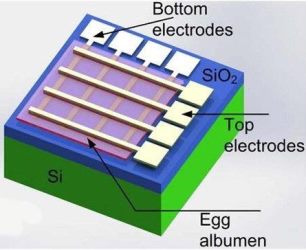 Dissolvable memristor made with egg proteins. Image source: American Chemical SocietyThe device incorporates magnesium and tungsten electrodes into a silicon wafer coated with diluted egg albumen. Performance of the water-soluble transient memory resistor was comparable to that of its non-degradable counterparts, and the components operated reliably for three months under dry conditions in the lab. The albumen and electrodes dissolved in water within 10 hours, while the remaining components degraded within 72 hours.
The egg-based memristors show bipolar resistive switching behavior with 1V voltage scheme and with a high-to-low resistance ratio in the range of 100:1 up to 10,000 to 1. This is higher than most other biomaterial based memristors.
Such biocompatible and dissolvable electronic devices could be useful for localized drug delivery and environmental sensor applications.