A Step Closer to Dissolvable Electronics
Engineering360 News Desk | May 06, 2016Tiny electronic sensors that can be implanted in the body and then disappear almost without a trace are now closer to reality following Chinese researchers' creation of a dissolvable device component out of egg proteins, magnesium and tungsten.
Transient electronics have many potential applications, from localized drug delivery to pollution monitoring. Unlike conventional electronics that contribute to growing amounts of harmful waste, dissolvable devices are designed to be compatible with the environment. To explore these possibilities, scientists have been working with an array of natural materials—including DNA, proteins and metals—to test how well they perform in electronic devices and whether they might cause side effects or damage when implanted.
Xingli He, of Zhejiang University's Department of Materials Science and Engineering, and colleagues wanted to build on this work and develop a transient memory resistor with dissolvable components. This electronic component, also called a memristor, is a new type of resistor that regulates the flow of electric current and can also “remember” charges.
The researchers rapidly spun diluted egg albumin, the white part of an egg, on a silicon wafer to turn it into an ultra-thin film. They then incorporated electrodes made out of magnesium and tungsten. Testing showed that the device’s performance matched that of non-degradable memristors.
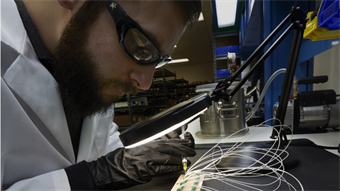
 Diluted egg albumin was rapidly spun on a silicon wafer to turn it into an ultra-thin film. Image credit: American Chemical Society. Under dry conditions in the lab, the components worked reliably for more than three months. In water, the electrodes and albumin dissolved in 2 to 10 hours in the lab. The rest of the chip took approximately three days to break down, leaving minimal residue behind.
According to the researchers, their work demonstrates a new way, using cheap, abundant and 100% natural materials, to fabricate biocompatible and dissolvable electronic devices for the forthcoming bioelectronics era, as well as environmental sensors for applications in the Internet of Things.