Watch a battery-free pacemaker vanish
S. Himmelstein | July 13, 2021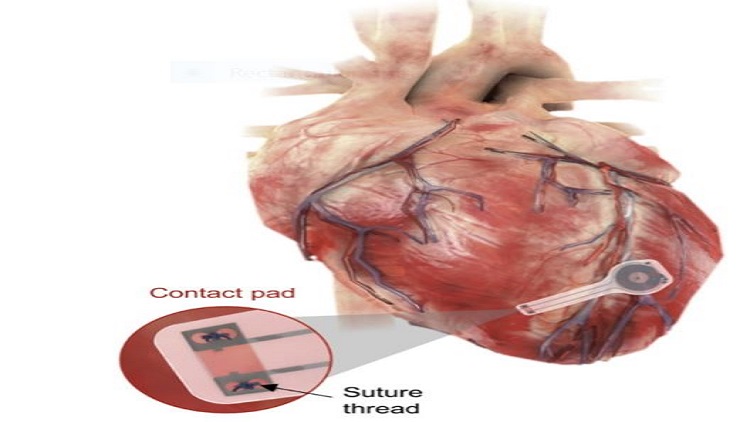 Illustration of the device mounted on myocardial tissue. Source: John A. Rogers et al.
Temporary cardiac pacemakers are commonly deployed to provide essential pacing for patients with short-term heart rhythm disorders following cardiac surgery or while waiting for a permanent pacemaker. These devices require external hardware with leads inserted through the skin, risking infection and limiting patient mobility, and additional invasive procedures to effect their removal. These risks can be eliminated by use of a newly developed wireless, battery-free, fully implantable pacing device that disappears after it is no longer needed.
The components of the transient pacemaker are biocompatible and naturally absorb into biofluids over the course of five to seven weeks, without needing surgical extraction. The device designed by researchers from George Washington University, Northwestern University and University of Illinois wirelessly harvests energy from an external, remote antenna using near-field communication protocols. The inclusion of this technology eliminates the need for batteries and rigid hardware, including wires or leads, which can introduce infections or become enveloped in scar tissue.
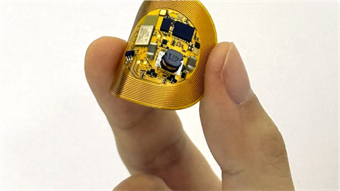
A power-harvesting receiver is assembled with an inductive coil made from tungsten-coated magnesium, a radio frequency PIN diode based on a silicon nanomembrane, and a dielectric interlayer of the biodegradable polymer poly(lactic-co-glycolic acid). Just 16 mm wide and 250 μm thick, the pacemaker also includes flexible tungsten-coated magnesium extension electrodes connected to dissolvable metallic contact pads, which attach to the myocardium to deliver the electrical stimuli.
Tests in animals confirmed that the device could deliver effective ventricular pacing and a maximum pacing distance (between skin and transmission coil) of 17 cm, validating its capability for long-range wireless energy transfer. The pacemaker largely dissolved within three weeks, and the remaining residues completely disappeared after 12 weeks.
The findings reported in Nature Biotechnology suggest that the device can achieve the necessary power transfer for operation in adult human patients.