Rutgers' team creates efficient spray technique for bioactive materials
Marie Donlon | September 15, 2023Coatings featuring biologically active materials for medical products have been developed by a team of scientists from Rutgers University.
Potentially paving the way for transdermal medication delivery — for instance, in the form of shot-free vaccinations — the team has devised a new approach to electrospray deposition, which is an industrial spray-coating process.
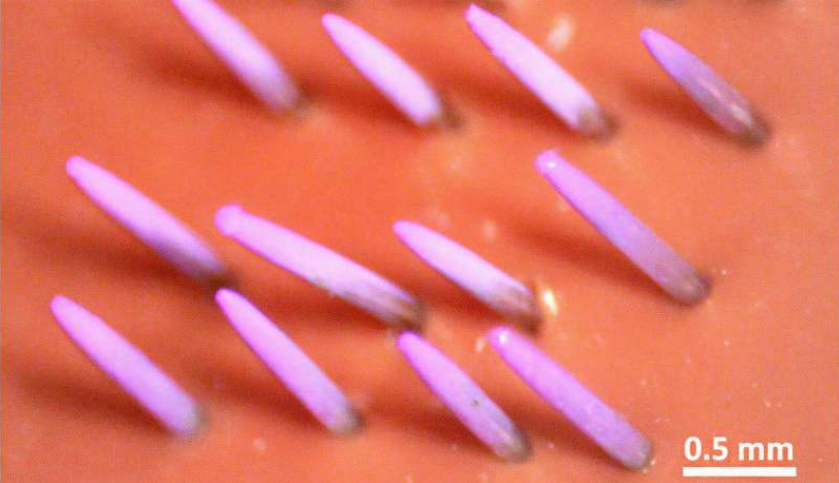 Dyed DNA vaccine coated on a microneedle array by efficient electrospray deposition. Source: Sarah H. Park/Rutgers School of Engineering
According to the Rutgers’ team, the new approach better controls the target region within a spray zone along with the electrical properties of the microscopic particles being deposited. The team suggests that greater command of those properties will mean more spray is destined to reach microscopic targets.
Electrospray deposition is a process wherein manufacturers apply a high voltage to a flowing liquid — for instance, a biopharmaceutical — which converts it into fine particles. As those droplets evaporate traveling to a specified area, a solid precipitate from the original solution is deposited.
"While many people think of electrospray deposition as an efficient method, applying it normally does not work for targets that are smaller than the spray,” explained the researchers. "Present methods only achieve about 40% efficiency. However, through advanced engineering techniques we've developed, we can achieve efficiencies statistically indistinguishable from 100%."
The team suggests that achieving possible 100% deposition efficiency will likely mean that no amount of the material would be wasted through this method.
An article detailing the process, “Efficient electrospray deposition of surfaces smaller than the spray plume,” appears in the journal Nature Communications.