
Spray coating protects plasma in fusion reactors
S. Himmelstein | January 12, 2024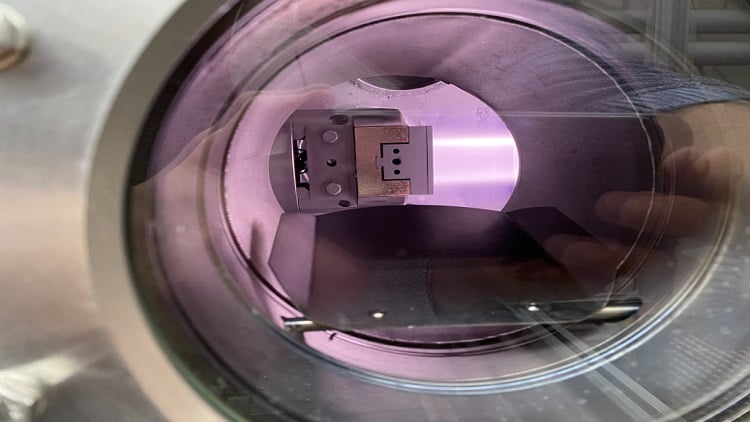 A cold spray tantalum sample is being exposed to deuterium plasma during testing. Source: Mykola Ialovega, University of Wisconsin-Madison
A problem encountered during the nuclear fusion process is the outgassing and loss of hydrogen ions from the hot plasma, resulting in a loss of power. A new spray coating process has been advanced by an international research team to stem the escape of hydrogen neutral particles under the hot, harsh conditions typical of fusion reactors.
A cold spray deposits a coating of tantalum, which can withstand high temperatures, on plasma-facing reactor walls. When applied to stainless steel and subjected to fusion-like conditions, the sprayed material proved effective in trapping hydrogen particles, which is beneficial for compact fusion devices. When the sprayed steel was exposed to even higher temperatures, the trapped hydrogen particles were released, in effect renewing the material so that it could be reused.
The cold spray deposition technology described in the journal Physica Scripta was demonstrated to successfully trap hydrogen isotopes and to withstand low-energy high-fluence deuterium irradiation and temperatures up to 1100 K.
“Another big benefit of the cold spray method is that it allows us to repair reactor components on site by applying a new coating,” noted the researchers. “Currently, damaged reactor components often need to be removed and replaced with a completely new part, which is costly and time consuming.”
The coating will be used on the Wisconsin HTS Axisymmetric Mirror, an experimental device that may form the basis of a next-gen fusion power plant being planned by Realta Fusion, a spinoff of the University of Wisconsin-Madison.
Researchers from University of Wisconsin-Madison, Pohang University of Science and Technology (South Korea), Aix Marseille University (France) and Forschungszentrum Jülich GmbH (Germany) participated in this project.




How long does this coating last?
I'm suspicious that they are not actually simulating fusion reactor conditions in order to give this coating a real test. I suspect the plasma is contained by magnetism and not by the container walls; actual plasma conditions for fusion would vaporize the tantalum coating and the SS walls. Has this been peer-reviewed? Or maybe I misunderstand what they are trying to do?