NIST Looks to Overcome Robots' Agility Limitations
Engineering360 News Desk | February 05, 2016The U.S. National Institute of Standards and Technology (NIST) is launching a simulation-based competition to solve the challenge of making robots more agile, versatile and easier to program.
The Agile Robotics for Industrial Automation Competition (ARIAC), a joint effort with IEEE, invites participants to devise the specific task-related challenges that will make up the competition, which will be unveiled at IEEE's International Conference on Automation Science and Engineering, Aug. 21-24, 2016, in Fort Worth, Texas.
Solutions will be demonstrated in a computer model of a real-world manufacturing operation.
According to NIST, programming efforts to integrate a robot into a manufacturing operation account for 45-60% of the cost of deploying a robot. Improving agility so that robots can perform a diverse set of tasks and be re-tasked on the fly would eliminate one obstacle to wider adoption of the technology, especially among small- and medium-sized manufacturers.
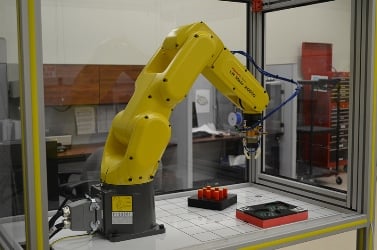 Programming efforts account for 45-60% of the cost of deploying a robot. Image credit: D. Russell/NIST.Craig Schlenoff, who leads NIST’s Cognition and Collaboration Systems Group, says overcoming agility limitations requires advances in four key areas:
- Failure identification and recovery, in which robots can detect failures in a manufacturing process and automatically recover from those failures.
- Automated planning, to minimize or eliminate the upfront time of programming a robot when a new product is introduced.
- A fixtureless environment, where robots can sense their surroundings and perform tasks on manufactured parts that are not in predefined locations.
- Plug-and-play robots, in which robots from different manufacturers can be swapped in and out without the need for reprogramming.
“We want to make sure that the challenges in this competition are truly representative of those facing industry,” Schlenoff says.
NIST will use the knowledge gained from ARIAC to further its efforts to develop metrics and test methods to measure robot agility, as well as tools that manufacturers can use to assess robot system agility.