The humanoid robot landscape of 2025
Qviro | July 13, 2025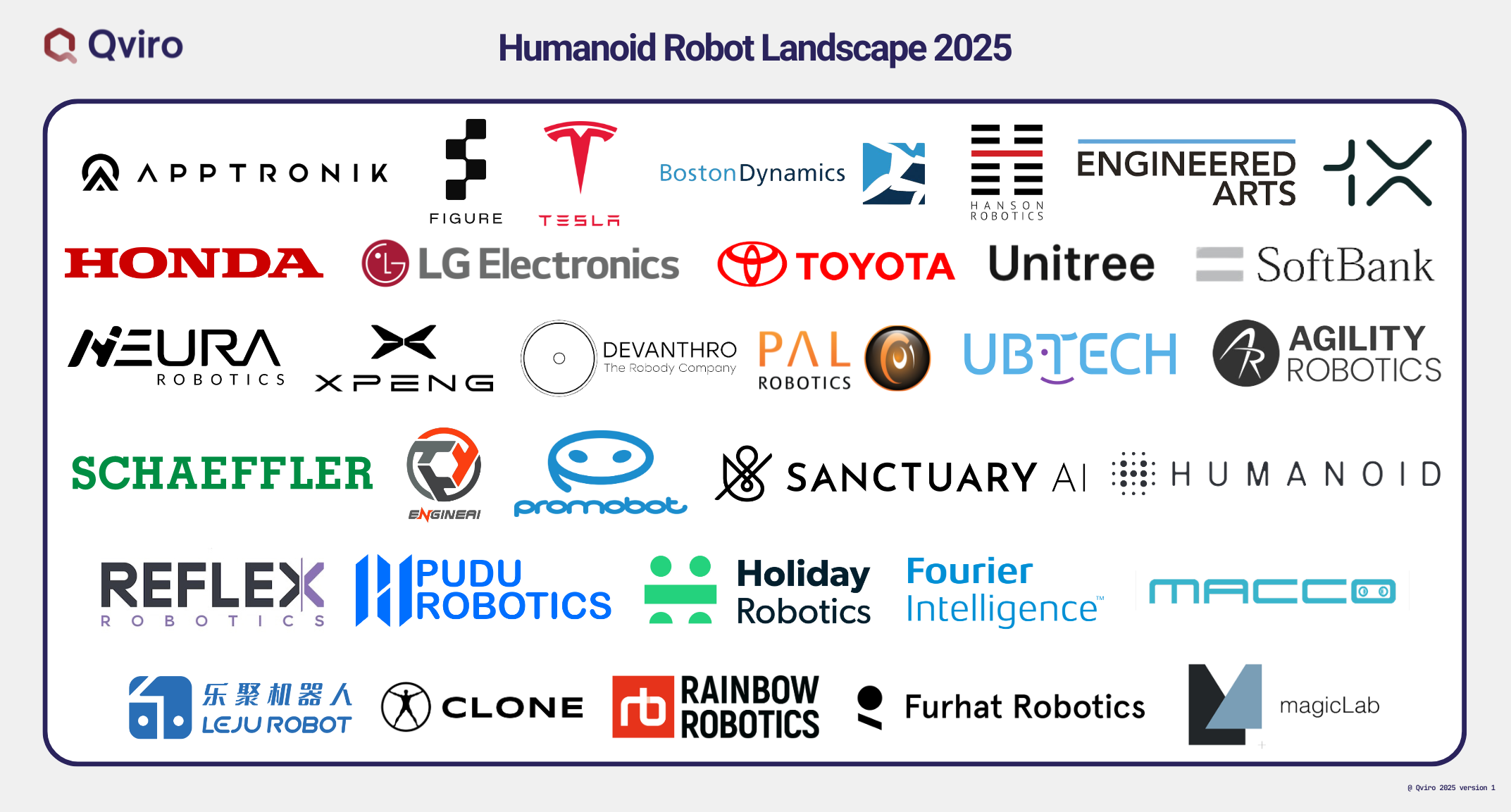 Click to enlarge
Humanoid robots are no longer a futuristic concept. They’re real, and they’re showing up in industries that once relied entirely on traditional automation. You might already be thinking about how one could fit into your factory floor.
At Qviro, we’ve seen a surge of interest in humanoid robots from engineers. Those interested are typically looking for flexible, human-like machines that can handle multiple tasks.
Key players in the humanoid robotics industry
Some of the most well-known names in robotics are now investing heavily in humanoids. Companies like Tesla, Boston Dynamics, and Agility Robotics are designing full-body robots that aim to work alongside humans in warehouses, factories, and more. Figure is another major player, building a general-purpose robot that’s attracting global attention. These companies are shaping expectations around performance, mobility, and real-world use cases.
You’ll also find younger companies pushing the limits. Apptronik and Sanctuary AI are developing robots that combine physical capability with AI decision-making. PAL Robotics and Devanthro are refining motion and control systems. These teams are smaller but move fast and take bold approaches to design and integration.
China and South Korea are scaling rapidly. Unitree and Fourier Intelligence are gaining traction with agile, cost-effective robots. Companies like Leju Robot and Rainbow Robotics are also making advances, especially in lab and industrial environments.
Understanding humanoid robots
Humanoid robots are machines designed to look and move like humans. Most of them have arms, legs, a torso and a head. Some can walk upright on two legs. Others roll or use different types of mobility systems. What makes them stand out is their ability to mimic human actions. That includes picking up objects, navigating spaces and using tools. Many models also include sensors and cameras to perceive their surroundings.
Humanoid robots can be thought of as plug-and-play workers. They fit easily into existing environments built for humans. There’s no need to redesign a floor layout, as they can open doors, climb stairs or work at the same stations as human employees. The flexibility means they can switch between tasks like assembly, material handling or inspection with relative ease. In some cases, operators don’t even need to reprogram them completely. That adaptability is what makes them so promising for modern manufacturing.
Humanoid robots are improving fast, but there are still limits. Most models have short battery life and move slower than traditional robots. Their walking stability can also vary depending on the surface. For manufacturers that value fast cycle times or 24/7 uptime, that needs to be factored into any decision.
Safety is non-negotiable. Make sure any humanoid robot complies with regional safety regulations. Look for features like collision detection, emergency stops and certified components. Also, review your existing risk assessments and update them before deployment.
Finally, also think about how these robots will work alongside your team. Some employees may worry about job security or feel uncertain around new machines. Clear communication and training are key.
Notable applications
Humanoid robots can take over tasks that are repetitive, time-consuming or physically demanding. Many of the robots designed by manufacturers featured in the 2025 landscape are built to lift, carry and transport objects. They can also be assigned tasks like fastening, assembling or operating simple tools. This helps reduce worker fatigue and improve line efficiency.
With built-in vision systems and precise movements, humanoid robots can assist in inspection tasks too. They can check for surface defects, confirm part placements or monitor consistency. This brings more accuracy to quality control processes and frees up skilled workers for other tasks.
Evaluating humanoid robots and vendors
The upfront cost of a humanoid robot can be high. Before investing, prospective buyers should look closely at their current setup. Humanoid robots are designed to work in human-centered environments, but operators should still need to check ceiling height, floor space, and safety zones. Make sure tasks actually benefit from a human-like form. For example, simple pick-and-place might be better served by a traditional arm or gantry robot.
Despite the price tag, if you’re dealing with labor shortages, repetitive strain injuries, or flexible task needs, the long-term savings may justify it. Also be sure to consider maintenance costs, downtime and training requirements too. Not all vendors offer the same level of support. Look for companies that provide setup help, software integration and after-sales service.
Conclusion
Humanoid robots are no longer experimental, they’re entering real production environments and offering new possibilities for flexible automation. With human-like mobility and task versatility, they can fit into spaces already designed for people and take on physically demanding or repetitive jobs. But like any emerging technology, they come with limitations.
The humanoid robot landscape 2025 infographic is a great starting point to explore what’s out there and decide if this technology fits your future plans.
Editor's note: This infographic appears here courtesy of Qviro. You can download the original infographic from their website.