Subsea Camera Offers Extended Range Compared with Existing Systems
Engineering360 News Desk | January 13, 2016A subsea camera has been developed that can capture images two to three times farther underwater than existing cameras. It also can calculate distances to objects, possibly making it easier to detect pollution on the seabed, facilitate marine species management and carry out subsea inspections and maintenance. Components for the prototype camera, part of the Underwater Time of Flight Image Acquisition (UTOFIA) project, were developed at a number of centers across Europe. Trondheim, Norway-based Foundation for Scientific and Industrial Research (SINTEF) assumed responsibility for project management, assembly of the components and image analysis.
Key to the camera's effectiveness is its use of range-gated laser imaging to reduce the effect of backscattering in turbid subsea environments. The accompanying figure shows a chronology of an underwater image capture at a distance of approximately 9 meters. The graph shows the reflected signal from a laser pulse as a function of time, with the first peak of the curve corresponding to backscattering from particles in the water. The second, attenuated peak corresponds to the reflection from the object that is being imaged.
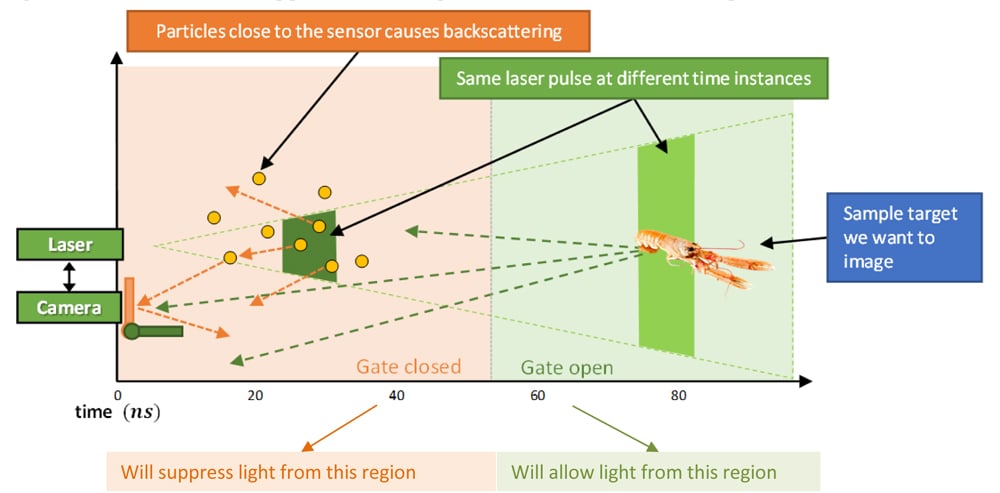 Range-gating reduces the effect of backscattering. Image credit: SINTEF. The camera shutter is kept closed for around 50 ns before it opens. Because the image is created from an integration of all light received, when the first 50 ns is gated out, most of the backscattering contribution to the fundamental noise is removed.
To demonstrate the camera’s functionality, the researchers constructed a frame that they placed on the seabed of the Oslo Fjord in an area characterized by turbid water. They took pictures of their “target” using the prototype. The images were significantly clearer when compared with those taken by a standard camera.
“The biggest problem with traditional cameras is that their range is reduced in poor visibility, particularly in coastal waters made turbid by suspended sand and clay particles," says project manager Jens Thielemann of SINTEF. "Such cameras have a very limited range under these conditions."
A second round of testing is set to be carried out in Copenhagen in February 2016, with a new, lighter prototype scheduled for completion by midyear. The intention is for that camera to weigh 5-10 kg, with a volume of between 5-10 liters, to allow for its installation on the hulls of surface vessels or on remotely operated underwater vehicles to monitor the seabed.