Ancient solutions to modern flight problems
Siobhan Treacy | April 17, 2020Researchers from the University of Bristol found that flying dinosaurs could provide solutions to modern flight problems, focusing on the pterosaurs, the largest animals to ever fly, suggesting that its flight capabilities could fix aerial stability and create self-launching drones and robots.
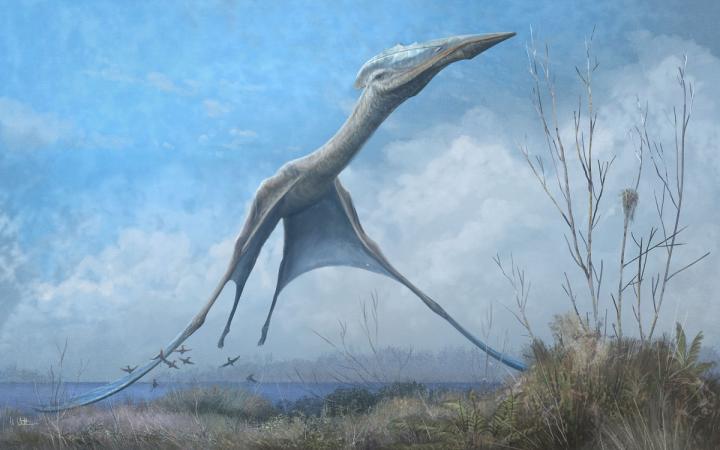 Reconstruction of the giant pterosaur Hatzegopteryx launching into the air, just after the forelimbs have left the ground. Source: Mark Witton
Typically, developers study modern birds and insects when designing aerotechnology. Paleontology does not often serve as inspiration for flight. But there are a few pterosaur fossils that could provide insight into the anatomy of dinosaur wings, which is essential to understanding their flight.
Currently, there are two to three well-preserved pterosaur fossils that allow researchers to see different layers within the wing membrane, giving insight into its fibrous components. Some are even preserved enough to show wing attachments beneath the hip. Membrane attachments can model the effectiveness of wing shapes, revealing what worked best for flight.
The team analyzed morphology and predicted flight mechanics of ancient flyers. This revealed novel tactics that modern birds do not have. In today’s animal kingdom, animals launch into flight with a strong leap or jump, known as a ballistic launch. Larger birds need a running start. But pterosaurs have a method that allows them to start flight from a stationary position, despite being around 300 kg. The wing membrane and robust muscle attachments of the fossils allowed the birds to complete a high-powered leap off of their elbows and wrists.
Drones require a flat surface to launch and have restricted methods for how they maintain flight. The pterosaur method could help overcome these restrictions.
Pterosaurs could also provide insight into preventing air flight instability, including resisting wing flutter with a new wing membrane structure.
This study was published in Trends in Ecology and Evolution.