Buzz off: Flapping wing drones for niche and stealthy airborne applications
Andy Tomaswick | June 18, 2025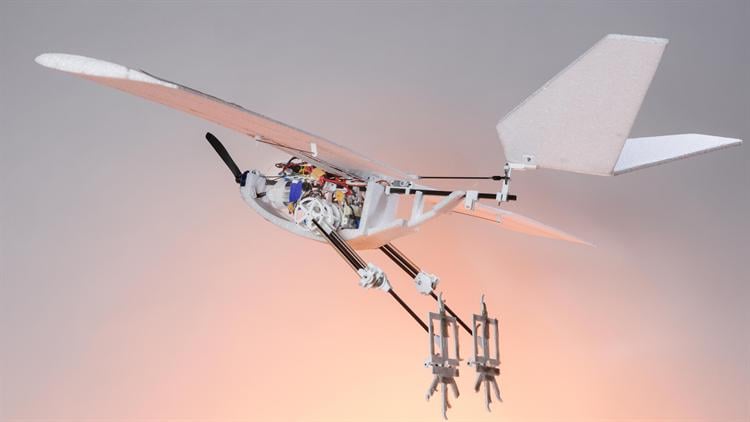 Source: EFPL
The buzzing of a drone has a familiar sound worldwide. Hear it, and immediately bystanders begin scanning the sky.
As drones become more pervasive - particularly on the battlefields of Eastern Europe - engineers and designers have sought ways to heighten their stealth. New designs, including those inspired by birds, could create much more stealthy and efficient drones. Still, they face additional technical hurdles before they can beat back the buzzing.
Flight check
That buzzing typically comes from the most common type of drone - a quadcopter. These have four separate rotors, which combined with some additional electronics, provide a stable, consistent flight that is easily controlled. They have been widely used in everything from military combat to search and rescue to surveying and photography.
But they have some disadvantages. Running four separate motors is energy intensive. Since batteries power drones, and most batteries are heavy, there's a noticeable trade-off between lifting capacity and flight times. Their design is also not-so aerodynamic, creating even more energy demand than other options. But most importantly for some end users, they are not stealthy. A drone's tell-tale buzzing makes stealth missions that require stealth, a non-starter for many users. Military and law enforcement might be the most obvious use cases, but it can also be important for things like wildlife observation or indoor uses. As drone shows become more common, so too does the sound of dozens of quadcopters; but that might be fixable with a more silent version.
Enter the flapping wing drone, a type of ornithopter, as popularized by the Dune franchise, Leonardo Di Vinci and others.
These bio-inspired designs operate as advertised. Instead of using rotors, they flap their wings to stay aloft. Doing so solves many of the problems of quadcopters. Ornithopters can be lighter, with less powerful motors and better aerodynamics, making them much more energy-efficient. But most importantly, they can be stealthy. No rotors mean no distinctive buzzing, allowing them to operate in ways that quadcopters cannot.
Ornithopters are broadly based on the flight mechanics of either insects or birds. Insect and bird-based UAVs have been under development for over 20 years. DARPA's Nano Air Vehicle (NAV) program began back in 2005 with the intent of offering military personnel small, quiet and adaptable UAVs for in-field scouting. Many of those features would also be lent to disaster relief, agricultural or crowd monitoring applications. The program produced some notable miniature UAVs, like the Nano Hummingbird from Nano Hummingbird from AeroVironment. At a quick glance, most observers would think this UAV is in fact a real but irrelevant bird.
DARPA quietly ended the NAV project back in 2011, presumably happy with the results. It is likely that this type of technology has already been adapted to for clandestine U.S. military applications.
This technology, or others from the NAV project, were not easily commercialized. But modern-day materials, control systems and motors have revived the concept, with successful demonstration flights of various bird-based designs in recent years, that have been able to overcome some of the key challenges with small-scale ornithopter.
Flapping against the wind
Modern-day ornithopters still face challenges, though. The small scale of the craft and natural aerodynamics are perhaps most notable.
Wind can buffet an ornithopter, just like it can a much larger passenger plane. While some wind can cause brief ups and downs, it can also cause underlying vibration in the structural system of the aircraft itself. Wing beats also have an obvious correlation with vibration. The mechanics of how those wing beats physically happen in a drone confound the problem with vibration. The ornithopter's body has no biological shock-absorbing system that has been evolutionarily developed over billions of years to dampen the vibrational feedback - like for birds. Vibrations from the motors, the gears and other mechanical and electrical components can transfer into the chassis. Another problem is the drone's attitude, that is, its orientation compared to the ground. In addition to inducing vibrations in the drone's structure, the wind could also force the drone's nose up or down.
These kind of flight irregularities make it tough to use sensitive instruments in a flapping-wing drone. This is what Lican Wu and their co-authors at Tsinghua University in China experienced for a LIDAR terrain mapping application. Their first challenge was vibration, which showed itself as random noise in the drone's altitude signal. Since the LIDAR system used for much of the terrain mapping was placed in a fixed position on the drone's underside, those attitude adjustments meant the LIDAR itself was unexpectedly pointed at different areas. LIDAR is a sensitive instrument, and that kind of variability is tough to process away, creating incorrect data throughout most of the terrain mapping run.
The authors offered solutions to both of these problems. Other sensors helped share the load, at least somewhat. Their modern ornithopter included a GNSS system to position them in the local area. It also has a series of IMUs that could relay the attitude back to the flight controller, even if the flight controller itself couldn't do anything to correct any misalignments. They also relied on taking terrain measurements while gliding to eliminate wing flapping as a significant source of noise. They also found a stabilizer might help to continually point the LIDAR sensor at the right area.
Many types of flapping drones could suffer from different problems. For example, if an insect-like ornithopter had wings that beat extremely fast, its buzzing would sound a lot like a more traditional quadcopter’s. Control algorithms could prove another challenge, as ornithopters have several controllable aspects that traditional quadcopters do not. That is especially true for the actual flapping mechanisms, which are hard to design in practice.
Cleared for takeoff
Despite these notable obstacles, flapping wing drones continue to find niche uses cases. Last year, New Mexico Tech revealed its flapping and swimming duck drones to monitor migrations. And EFPL researchers debuted RAVEN, an orinthological drone that takes off from bird-like legs.
Ornithopters themselves remain an active area of development, as there seem to be several advantages to unlock. There are plenty of ideas on how to tackle the technical challenges - and more inspiration to take from nature.
Dreams of flying through the sky like a bird, which go all the way back to Daedalus, will never truly die - even if humans manage to do so using small robotic proxies.