Green chemical production method takes cues from nature
Siobhan Treacy | January 10, 2020Researchers from the Imperial College London have found a greener way to produce toxic chemicals. The new method takes cues from the way that organisms produce toxic chemicals without harming themselves. This could reduce the need for fossil fuels to create chemicals, plastics, fibers and fuels.
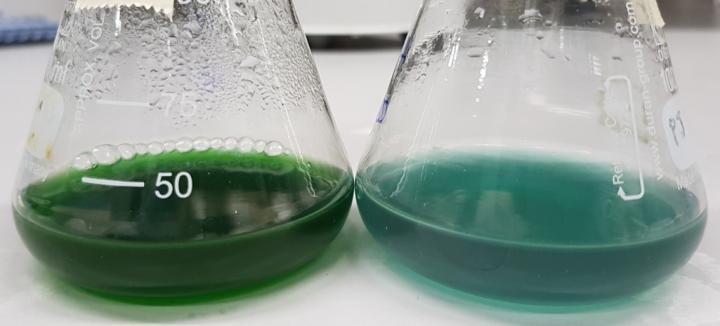 Bacteria producing chemicals with (L) and without (R) the bioderivitization step. With bioderivitization, the bacteria are healthier (darker green). Source: Patrik Jones/Imperial College London
The new alternative production method engineers microorganisms to sustainably produce chemicals directly from atmospheric carbon dioxide. Many chemicals produced this way are toxic to microorganisms. When organisms produce chemicals that are toxic, they make small modifications to the chemicals to make them harmless. This results in derivatives of the original chemicals, which can be later restored to the original state using simple chemistry.
The team used genetic engineering to program E. coli and cyanobacteria to make 1-octanol, which is a chemical harmful to bacteria that is typically used in perfumes.
If this method was scaled up for industrial uses, the engineered bacteria would produce a non-toxic 1-octanol derivative, which can be later recovered and transformed back to 1-octanol. The new method produced more 1-octanol than a system without the derivatization step. This is likely because the derivative is less toxic and more soluble. The more soluble a derivative is, the faster a chemical will move away from the cells. The team was able to produce 1-octanol without affecting bacterial growth.
The researchers aim to create a complete system that can produce a derivative and recover the desired chemical. This would refine the production process of toxic chemicals.
A paper on the study was published in the Proceedings of National Academy of Sciences.