Researchers develop a device that helps amputees feel artificial limbs
Marie Donlon | September 10, 2019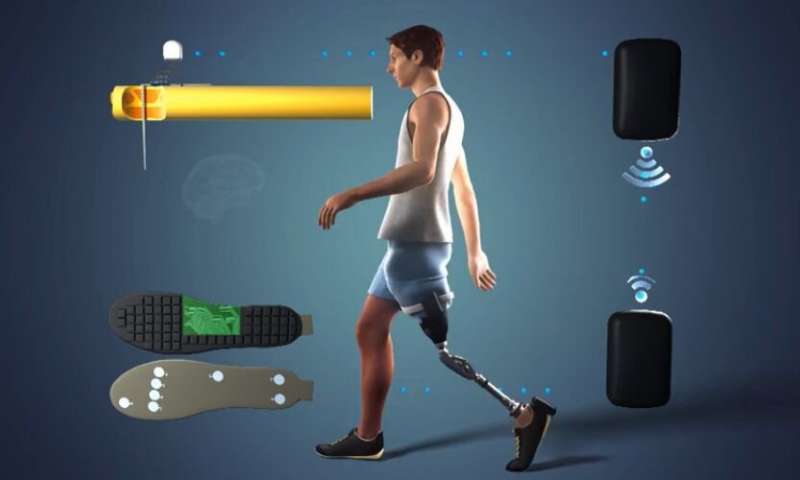 A breakthrough device makes it possible for someone amputated above the knee to "feel" a prosthetic leg, resulting in greater stamina, stability and mobility. Source: Swiss Federal Institute of Technology in Zurich
An international team of researchers led by the Swiss Federal Institute of Technology in Zurich recently unveiled a device that will enable those with above-the-knee amputations to “feel” a prosthetic leg.
The device, demonstrated on volunteers with such amputations, is a series of sensors affixed to a mechanical limb surgically attached to nerve endings in the volunteers’ thighs. This connection enables the wearer to feel the prosthetic leg while also reducing, if not entirely eliminating, the often painful “phantom limb” sensation afflicting the majority of amputees.
In the proof-of-concept study, the researchers managed to partially restore the flow of signals that travel from the limb to the brain, informing the person of details such as road conditions, by placing sensors beneath the soles of the amputee's prosthetic foot as well as connecting to the integrated angle sensor of the electronic knee. This is done as doctors implanted electrodes into the amputee’s thigh, attaching them to nerve endings that used to send and receive messages from the now amputated lower limb. Following connection via the wires that pass through the amputee’s skin, the sensors and electrodes partially restore the loop of feedback, delivering enough sensation to improve the confidence of wearers as well as their stamina, stability and mobility.
Additionally, the device reportedly works even years following the removal of a leg, according to researchers. That is because there exists enough accumulated knowledge in the nerve fibers to evoke sensations with electrical stimulation.
The loop of feedback is generally intact for non-leg amputees whose nerves, which are located in both the feet and the legs, transmit consistent electrical impulses to the brain with real-time information such as when a road is uneven, full of pebbles, slippery or sloping up or down. This information enables the brain to make immediate corrections for such conditions, thereby preventing or catching a fall or for altering the amount of force necessary. Yet, artificial legs no longer experience that feedback, which makes it challenging for amputees to walk steadily or with confidence.
"They can't entirely trust their prosthesis, so they rely too often on their intact leg, which reduces mobility and causes them to tire quickly," said Stanisa Raspopovic, a professor at the Swiss Federal Institute of Technology in Zurich who led the international team of 20 researchers.
The research team believes that additional tests are necessary on the device before bringing it to market. Eventually, they hope to create a fully implantable system with wireless neuro-stimulation, thereby eliminating the need to pass wires through the skin. The research appears in the journal Nature Medicine.