University engineers develop a bionic leg for amputees
Marie Donlon | October 30, 2019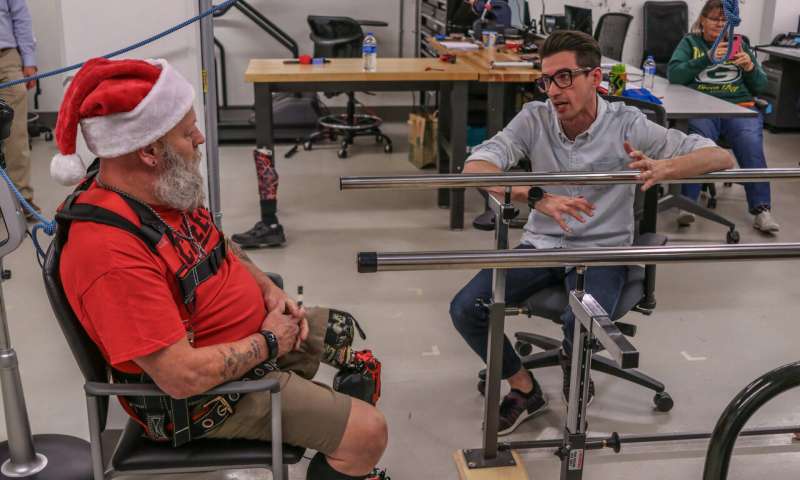 An amputee tests the bionic leg in the lab. Source: Mark Helzen Draper/University of Utah College of EngineeringEngineers at the University of Utah have developed what they are calling a bionic prosthetic leg for amputees.
The lightweight prosthetic leg, aptly referred to as the “Utah Bionic Leg,” is designed to improve how amputees navigate the world around them, enabling the wearer to walk with greater strength and stability, thus ensuring their safety and improved quality of life.
To achieve this, the team of University of Utah engineers, led by mechanical engineering assistant professor Tommaso Lenzi, has equipped the self-powered prosthetic limb with motorized joints in both the knee and ankle, a computer processor, force and torque sensors, gyroscopes, accelerometers and artificial intelligence (AI) — all of which work together in real-time, sending and receiving data about the conditions surrounding the wearer. Factors such as walking speed and step length communicated to the bionic prosthetic will reportedly help to reduce stress on the body, helping the wearer to safely navigate around obstacles and up and down stairs, according to its developers.
Weighing roughly 6 lbs, the prosthetic, which is composed primarily of aluminum and titanium, is almost half the weight of standard prosthetic limbs. This weight reduction serves to reduce the wearer’s energy expenditures, according to the team.
The team intends to further develop the bionic prosthetic with help from two recently awarded grants from the National Institute of Health and the National Science Foundation.