Introducing 3D Scanning Not Limited by Object Size, Resolution
Engineering360 News Desk | September 10, 2018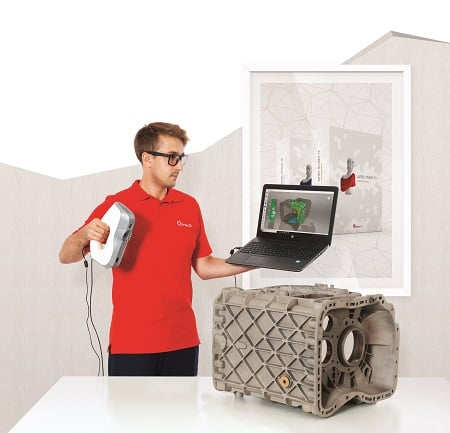 Source: Artec 3DA new 3D-scanning software release, Artec Studio 13, incorporates high-powered algorithms designed to allow users to produce, edit and process 3D data regardless of an object’s size or resolution.
Software developer Artec 3D says that even a 500 million polygon data-set is no challenge for the software. Artec Studio 13’s upgraded Global Registration tool can successfully assemble up to 250% more object types than its predecessor, Artec Studio 12, even under subpar scanning conditions. In addition, the tool has doubled in speed, while fine registration can be performed 50 times faster - enabling users to quickly jump to the next stage in data processing.
The new release also incorporates an “X-ray Mode” that simplifies the scanning of complex objects by enabling users to examine raw scan data for potential problem areas. The mode makes raw scan data semi-transparent and deletes the noise around a scanned object - allowing users to judge the quality of scan data right after capture, prior to entering the processing stage. As a result, users can immediately identify whether the scanning process missed areas of an object, or included holes, misalignments or other issues.
Artec Studio 13 also introduces a 3D radar feature for increasing the intuitiveness of the scanning process; an upgraded Max Error Mode that automatically inspects and highlights any areas that may need extra attention; and smart 3D rendering that can automatically detect the user’s computer specs and adjust its system resource use accordingly.
In addition to the new software, the company will have its full line of handheld scanners on display at the International Manufacturing Technology Show (IMTS), which runs Sept. 10-15 in Chicago. According to Artec 3D, its Artec Leo scanner is the first AI-based, all-in-one handheld that can capture and automatically process large amounts of data on a single device.
To learn more, visit Artec Studio 13.