Biosensors Based on Semiconducting Plastics
S. Himmelstein | June 26, 2018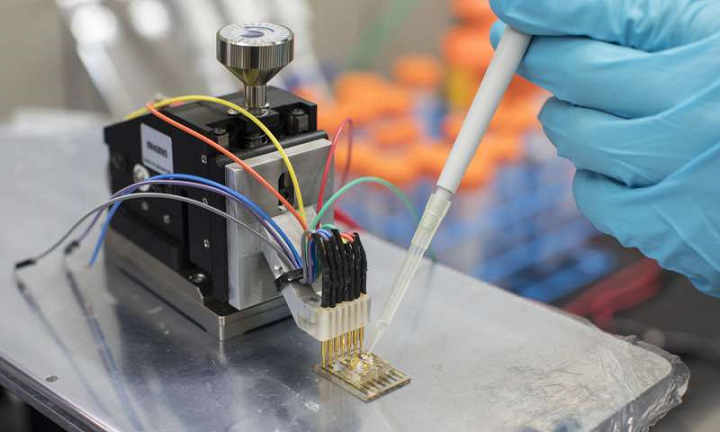 A low-cost sensor composed of semiconducting plastic could be used to diagnose or monitor a range of health conditions. Source: KAUSTSemiconducting plastics such as those used in solar cells and flexible electronics may now find biomedical applications. These materials were used by an international team of researchers to design a low-cost sensor that can track concentrations of lactate, glucose and other critical metabolites present in sweat, tears, saliva or blood. If integrated into a diagnostic device, the sensor could allow health conditions to be monitored quickly and accurately.
A newly synthesized p-type semiconductor polymer served as a molecular wire, directly accepting electrons generated during electrochemical reactions. On exposure to bodily fluids, the material absorbs ions and swells, gradually merging with the liquid. Higher sensitivity relative to conventional metal electrode-based sensors is the result.
When incorporated into transistors and other complex circuits, the sensor’s signal can be amplified and respond to tiny fluctuations in metabolite concentration, despite the miniature size of the devices.
Initial tests of the sensors were used to measure levels of lactate, which is useful in fitness applications or to monitor patients following surgery. The sensor can also be modified to detect other metabolites, such as glucose or cholesterol by incorporating the appropriate enzyme, and the concentration range that the sensor can detect can be adjusted by changing the device's geometry.
The device does not incorporate gold or platinum, ensuring low manufacturing cost and ease of integration into flexible substrates for wearable or implantable sensing applications.
Scientists from École Nationale Supérieure des Mines (France), University of Cambridge (U.K.), King Abdullah University of Science and Technology (Saudi Arabia), Imperial College London (U.K.) and Northwestern University contributed to this research, which is published in Science Advances.