Skull-drilling Robot Developed by PhD Student to Cut Operation Times
Marie Donlon | May 01, 2018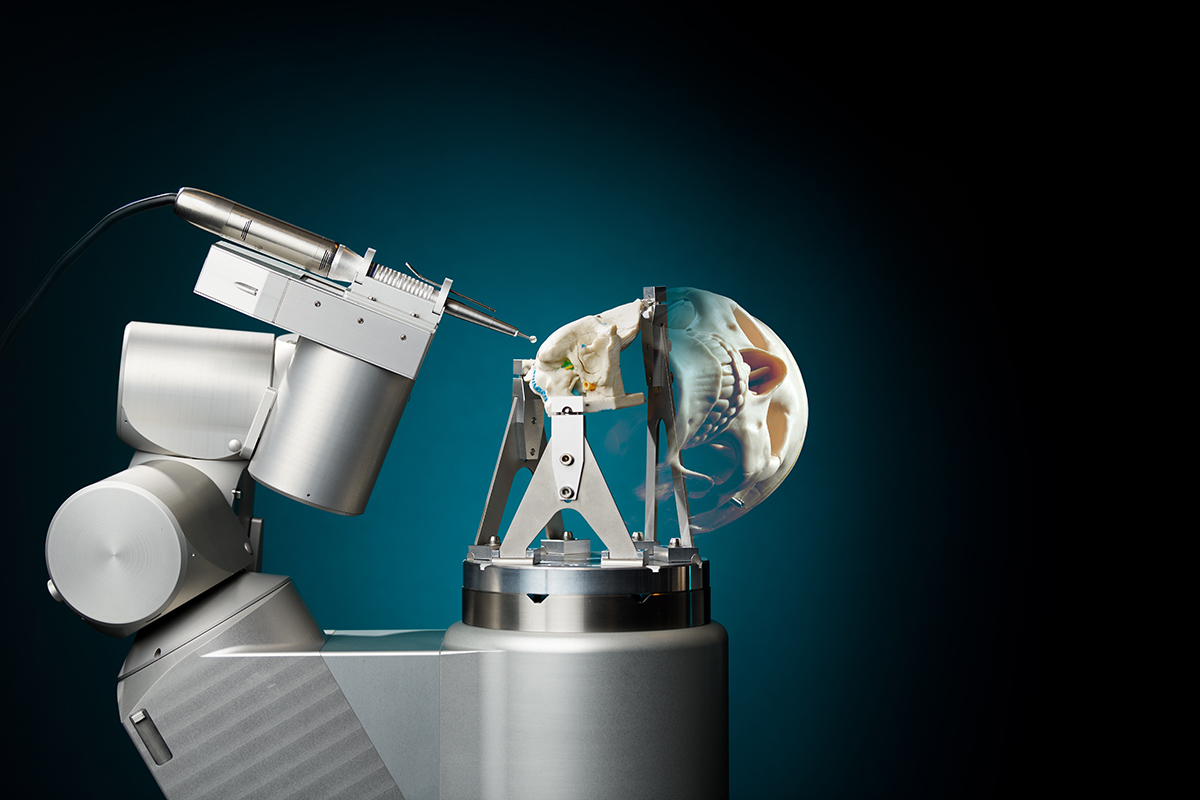 Source: Bart van Overbeeke. As a component of his Ph.D. research, a student at Eindhoven University of Technology (EuT) has designed and built a robot capable of drilling a hole into a patient’s skull.
A critical part of surgeries for treating illnesses such as cancer and infection, surgeons often spend long hours fixed to the same spot drilling a patient’s skull. The task, which requires a combination of both precision and strength, is a complicated one for surgeons as they must avoid motor and sensory nerves while also contending with bone fragments and blood obscuring the view. As such, the process can take several hours.
However, tasked with developing a robot that could take over this complicated step, Ph.D. student Jordon Bos designed and built RoBoSculpt. After sitting in on a number of operations, Bos developed a prototype of the bot that is equipped with a drilling arm capable of holding a surgical drill. With seven axes of motion, the drill is controlled by a surgeon using a CT scan of a patient’s skull to guide the robot.
Although the robot isn’t expected to be operational for roughly five years, Bos and his team of researchers believe that it will one day help cut time spent in the operating room as well as being able to perform the drilling functions more accurately than human surgeons.
"This is an important step toward the operating room of the future. RoBoSculpt is an optimal collaboration between the surgeon and the machine; they really complement each other to achieve the best results for the patient,” said Dr. Dirk Kunst, who worked on the project along with Bos.