Impressive worm robot pumps water from head and tail
Marie Donlon | November 03, 2026A new robot developed by researchers at New York University (NYU) adapts to and traverses changing terrain without adding customized appendages. Rather than relying on specialized mechanisms for each environment, WorMa adapts by redistributing the mass it already possesses.
Called WorMa — a portmanteau of “worm” and “mass” — the robot is about 20 in long and consists of five links connected by four joints. WorMa features a latex balloon water tank in both its head and tail, allowing it to redistribute its mass.
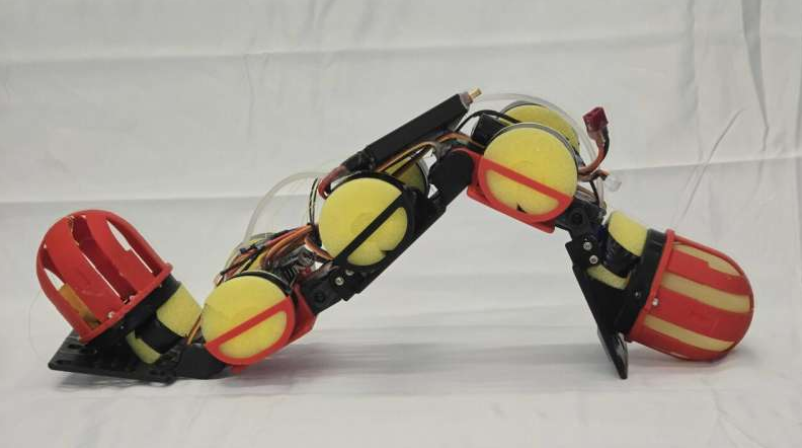 Source: Nana Obayashi
An onboard pump moves about 300 g of water between the two tanks. Shifting the water changes how the robot interacts with the terrain, allowing it to adjust its traction, climbing ability and swimming performance.
When the water is moved toward the head, WorMa gains additional traction and can climb slopes as steep as 19.5°. Meanwhile, moving the water toward the tail produces a different effect. The tail-heavy configuration increases WorMa’s swimming speed up to 26% and improves swimming efficiency by 52%.
By shifting its weight, WorMa successfully traversed a route featuring flat ground, a step, a slope and open water, thereby demonstrating its ability to transition between different types of terrain.
For example, to climb a step, the robot approaches with water in its head for traction, shifts the water to its tail, raises its head and pushes itself closer, then moves the water back to its head to anchor and pull itself up — a sequence that lets it clear steps as high as 6 in.
With more responsive pumps and sensor-enabled controls, future iterations of WorMa could detect changes in terrain and automatically adjust its weight distribution in real time.
An article detailing WorMa, “An Undulatory Robot With Center of Mass Regulation via Internal Fluid Redistribution for Amphibious Locomotion,” appears in the journal Advanced Robotics Research.