
Giant Device Will Help Clean Up Plastic in the Ocean
Marie Donlon | April 25, 2018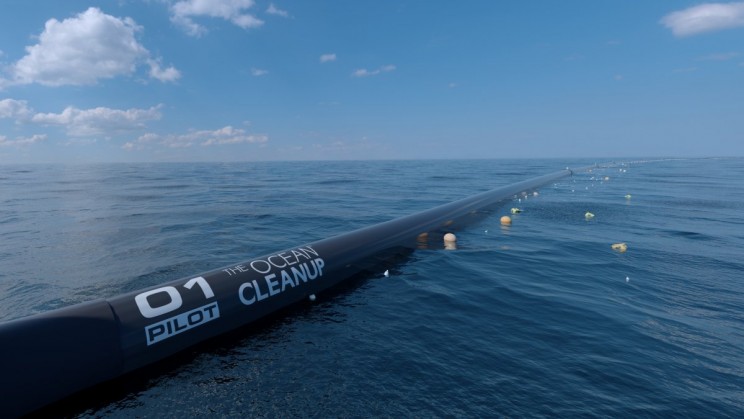 Source: The Ocean CleanupA long-awaited system of tubes designed to help rid the ocean of plastic waste will make its debut this week as it is installed in the Pacific Ocean.
Developed by the non-profit organization The Ocean Cleanup, the device is a system of floating plastic tubes that, held by floating anchors, sits on the ocean’s surface capturing and collecting plastic and other waste.
Although a durable nylon screen attaches underneath the system so that it also captures plastic below the surface, it has been designed so as not to ensnare marine life as well.
The process for installing the device is a slow-moving one, according to the nonprofit. As a first step, a section of the tube will be towed from San Francisco Bay to the coast of the Farallon Islands as a test of the tubes durability when towed.
Returning that section of tubing to San Francisco Bay, it will then be attached to a larger section, forming 2,000 feet of tubing. Once assembled, the entire system will be taken to an area 200 miles from the shore to test the device in open water. Eventually, the system will embark on a three-week journey to the Pacific Garbage Dump where it will be used to collect waste over the long term.
Officials expect that by late fall, a shipment of the plastic captured by the system will be returned to shore for recycling and, in some cases, used to create other goods.



First I would make this device out of Florescent orange plastic so no one runs over it out there. Adding more plastic to remove plastic is a little confusing to me. Something tells me the first storm it goes through will rip it into pieces and then we will need another device out there to clean up this one. Ironic huh?
In reply to #1
At least some folks are trying to find a solution. Do you have a better alternative?
If it breaks up and adds more plastic to the ocean, then nothing is actually a better alternative.
The orange color is a good idea but ships that cruise the ocean at great distances from shore are typically not small boats and cannot maneuver to avoid objects. It has to be charted and large marker buoys placed at intervals.
A better idea? How about putting a bunch of people who need jobs on ships that make 2 week tours to the Pacific garbage patch? Think of the over time pay! They could return with a cargo ship load of plastic! Oh, wait, that would be good old fashioned work. sorry. ;)
Let's review your concerns. In transport it will use shipping lanes as do all other vessels in open water. When positioned it will be in the midst of a vast garbage dump, a location avoided by all vessels willingly as they do not wish to travel through trash. Prototype testing is for the purpose of verifying its durability for the intended use and environment. The intent is to collect and recycle materials and thus create a much needed industry that provides....JOBS. The problem isn't plastic. The problem is people that dump their waste into the ocean rather than do the responsible thing of recycling which might incur a small cost and effort. As for your concern, you need to go back to school and have your teachers better prepare you for the real world. The world is changed by people who show up. The company is an NPO.
I agree that it must be very noticeable to ships and other boats to prevent collisions. A bright color will help during the day, but this will be deployed at night and in thick fog conditions. It should have flashing lights and radar visibility. Putting a bell or horn such as found on some navigational buoys could also help. The U.S. Coast Guard should be consulted in making this safe for ships and recreational vessels.
As this will be used to collect plastic and other floating debris, it would be a bonus if it were constructed of recycled materials as much as possible.
Thanks to this organization for helping to make our oceans and planet a better place for all!!!!
I wonder if recycling can pay for transport and sorting of plastic from mid Pacific ocean? If pre sorting is done at collection, there will still be a lot of this stuff that it’s not economical to return to land from there.
For this, there exists an alternative. A “trash compactor ship” could compact the plastic so it is close to the density of water, then add a bit of something cheap and dense (coal ash, slag, heavy metal processing waste, gravel). Do this very finely so the plastic cannot escape and float back to the surface without breaking down.
Then, sink it to the bottom of the Pacific.
Definitive studies need to be done, but it seems likely that carbon dioxide sent to the ocean bottom never makes it back. You now get rid of the plastic waste, and also accomplish carbon capture and sequestration for the fossil fuel that went into producing it.
In reply to #6
I just remembered watching a documentary about why our plastic waste used to end up in China and now ends up in landfills in third world nations. The low quality of plastic going to China (dirty and degraded) caused them to reject most of the plastic waste submitted for recycling. One expert explained that plastics that were subjected to UV exposure for too long, were no longer recyclable. Before we get excited about the reuse or value of the captured plastic, we should take a look at the quality after floating for a long time under the sun. We might be able to also use it as fuel, but I'm not an expert, just remembering what was said on TV :)