Tracking plastic pollutant travel with GPS and satellite technology
S. Himmelstein | December 08, 2020How far and fast can a plastic bottle sail through a riverine system? The transport of plastic pollution from riparian to marine systems was traced by monitoring the fate of polyethylene terephthalate (PET) bottles dropped in the Ganges River. Open source tracking technology was used by National Geographic Sea to Source Ganges Expedition researchers to document the contribution of this river to ocean plastics, now estimated at 0.12 million tons/year.
Twenty-five 500 ml PET bottles were modified to accommodate ARGOS satellite transmitters and global 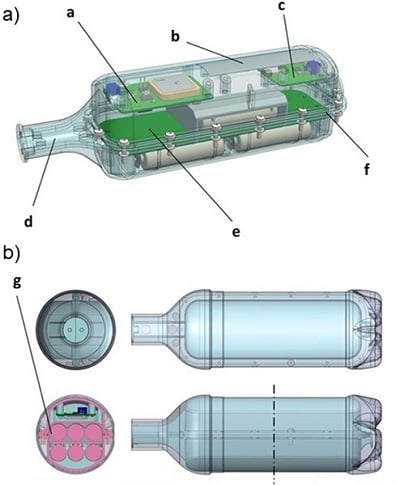 a) Transparent schematic shows battery and electronics placement inside bottles; a = GPS board, b = cellular antenna, c = cellular or Argos satellite board, d = CNC-milled enclosure, e = battery board, f = O-ring seal. b) Transparent views and orientation of batteries; g = positioning of AA lithium batteries. Source: Emily M. Duncan et al.positioning system (GPS) equipment. The cellular and satellite technologies enabled tracking of the plastic litter as it traveled through the Ganges system to the Bay of Bengal.
Bottles launched in the Ganges appeared to move in stages, occasionally getting stuck on their way downstream. Once reaching the sea, the bottles covered far greater distances, following coastal currents at first but then dispersing more widely. One was observed to travel 1,768 miles in 94 days.
The low cost, open source tracking technology could be useful in identifying habitats associated with accumulations of plastic debris and those most vulnerable to degradation. These plastic pollution tracking tools are expected to provide data, which can inform remedial regulatory measures and educational outreach programs to raise public awareness of plastic pollution problems.
Researchers from the University of Exeter (U.K.), Zoological Society of London, University of Dhaka (Bangladesh), University of Georgia, University of Plymouth (U.K.), National Geographic Society and Icoteq Ltd (U.K.) participated in this study, which is published in PLOS ONE.