Here's How the Bomb Cyclone Impacted Electricity Markets
David Wagman | January 23, 2018Cold and snowy weather in early January 2018 resulted in record levels of U.S. natural gas demand and boosted wholesale natural gas and power prices around the country.
Analysis from the Energy Department's Energy Information Administration (EIA) says that a constrained natural gas pipeline network led to a "significant increase" in oil-fired and dual-fuel generation in New England, New York and, to a lesser extent, in the Mid-Atlantic.
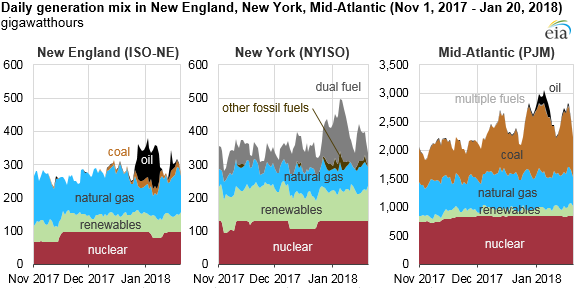 Source: EIADay-ahead daily average peak-period power prices for Jan. 5, 2018, one of the coldest days of the "bomb cyclone" weather event, reached $247 per megawatt-hour (MWh) in New England and New York. Prices reached $262/MWh in the Mid-Atlantic. This compares to $30/MWh–$50/MWh average prices in the preceding six weeks, according to the EIA.
Power markets in the Northeast and Mid-Atlantic have become more reliant on natural gas over the past several years following the retirement of electricity generators that use fuels other than natural gas.
The EIA indicates that the "relative moderation" in power price spikes during this year’s cold snap — despite higher natural gas prices — reflects market rule changes and winter preparedness actions taken by the region’s grid operators to improve winter reliability.
ISO-NE
The Independent System Operator of New England’s (ISO-NE) Winter Reliability Program has provided incentives for generators to procure adequate onsite fuel supplies for winter and spurred 1,774 megawatts (MW) of natural gas-fired generators to add dual-fuel capability. That capability allows them to switch fuels or co-fire multiple fuels simultaneously.
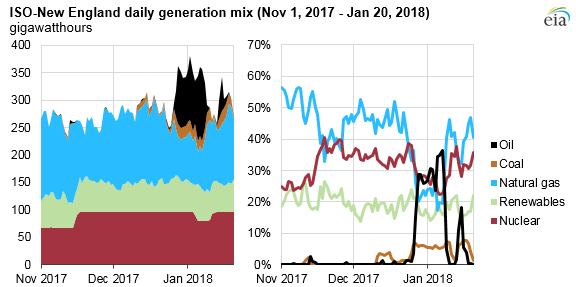 Source: EIAMore than one-third of New England’s natural gas capacity has dual-fuel capability with oil as their secondary source. About 40 percent of oil capacity can switch to natural gas, and about 50 percent of coal capacity can switch, mainly to oil.
During the 12-day span from Dec. 28, 2017, to Jan. 8, 2018, oil and coal made up, on average, 29 percent and 6 percent, respectively, of ISO-NE’s generation mix. Natural gas dropped at one point to a low of 17 percent of the mix. One of the region’s three nuclear plants, Pilgrim, experienced an unexpected outage for six days during that period.
 Source: EIAISO-NE has also made market design changes to improve winter reliability, including allowing generators to submit and update supply offers for each hour of the day as opposed to a single supply offer for an entire day. Dual-fuel generators may now specify the percentage of fuels they plan to use and the costs for each fuel. These changes allow generators to offer their resources to the market with more accurate representations of their operating costs.
NYISO
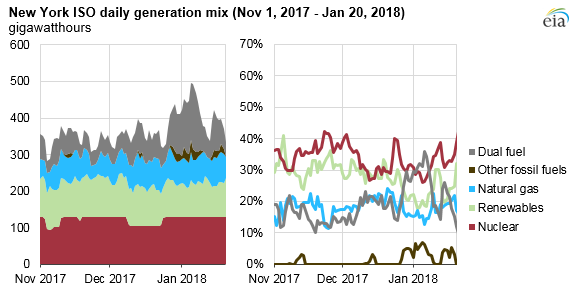
During the 12-day period from Dec. 28, 2017, to Jan. 8, 2018, dual-fuel generators burning oil and natural gas accounted for, on average, 30 percent of New York ISO’s (NYISO) generation mix. Coal and oil-only generators together averaged 5 percent. Nuclear generators accounted for about 30 percent of total generation, and dedicated natural gas and renewables accounted for the remaining 35 percent.
In New York, natural gas makes up more than half of the state’s total generating capacity, and about 70 percent of natural gas capacity can switch to oil. About 20 percent of oil capacity can switch to natural gas, and 13 percent of coal capacity can switch to oil or natural gas.
 Source: EIAThe EIA says that NYISO has taken actions similar to those in ISO-NE to improve winter reliability. NYISO increased generator fuel surveys and site visits, used generators with higher-priced offers when units committed in the day-ahead market could not run, and developed a process with New York state agencies for generators to request temporary emission waivers if needed for reliability.
NYISO made several market design changes, including increasing the system’s total operating reserve requirement from 1,965 MW to 2,620 MW. It also implemented new pricing methodologies that allow energy and ancillary service prices to rise higher to more accurately reflect costs for maintaining reliability, especially during reduced supply periods.
PJM
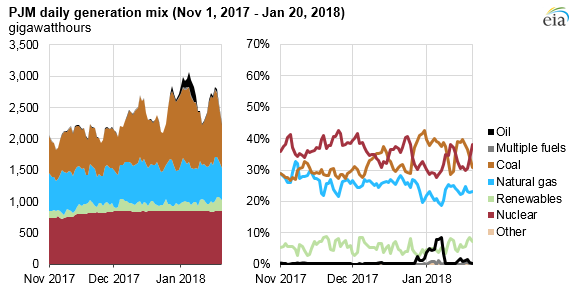
PJM in the Mid-Atlantic region is a much larger system that relies on natural gas to a lesser extent than ISO-NE and NYISO, the EIA says. About 40 percent of the market’s natural gas generators can switch, mainly to oil, while 15 percent of coal capacity can switch to natural gas or oil, and 4 percent of oil capacity can switch mainly to natural gas.
Oil generation peaked at 9 percent of the generation mix on Jan. 7, 2018, and averaged 4 percent during the 12-day period from Dec. 28, 2017, to Jan. 8, 2018. Coal generation averaged 40 percent during the same time period, compared with about 30 percent the week before, according to the EIA.