Big Nuke Looks Profitable...Mostly, Report Says
David Wagman | January 24, 2018The two-unit Millstone nuclear station in Connecticut, owned by Dominion Energy, should remain profitable through 2035 under a number of scenarios, according to a draft report prepared for the state's regulatory commission.
However, additional cost information provided in late 2017 after Congress passed a tax reform bill suggests heightened risks that could force the plant to retire early.
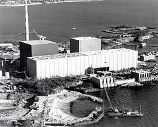 The two-unit Millstone nuclear station. Credit: WikipediaThe report was prepared by staff of the Connecticut Department of Energy & Environmental Protection and the Connecticut Public Utilities Regulatory Authority.
Millstone is New England's only multi-unit nuclear power plant. Unit 2 is an 882 megawatt (MW) Combustion Engineering designed pressurized water reactor. It entered service in 1975. Unit 3 is an 1,155 MW Westinghouse designed pressurized water reactor. It entered service in 1986.
The draft report says that Millstone's economic viability hinges on energy market revenues and plant operating costs. An economic assessment concludes that both units are economically viable under expected market conditions through 2035 and "thus unlikely to retire prior to that date."
Following passage of the Tax Cuts and Jobs Act in late December, Dominion submitted to the commission confidential documents with revised cost estimates. Additional analysis by the report's authors concludes that "when some adjustments are made, the financial viability of Millstone’s continued operation could be at risk."
Over-dependence on Gas
The report says that retirement of Millstone’s 2,200 MW facility would not trigger the need for new capacity in Connecticut specifically, but it would cause the New England region as a whole to need new generation capacity. Any replacement capacity would likely be natural gas-fired, "exacerbating security and system reliability issues due to the region’s over dependence on natural gas," according to the report.
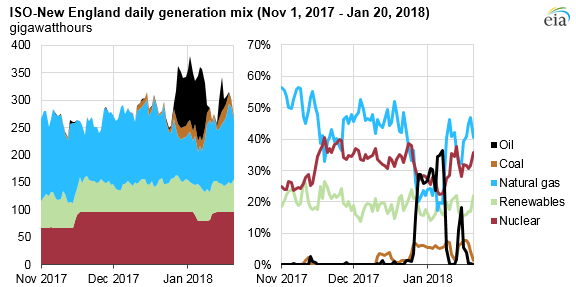 During January's cold snap, power generators burned oil to generate electricity as demand rose. Credit: EIAPower markets in the Northeast and Mid-Atlantic have become more reliant on natural gas over the past several years following the retirement of electricity generators that use fuels other than natural gas.
Ironically, Millstone's owner, Dominion, is one of the region's major players in natural gas markets. The company is developing a liquefied natural gas export terminal in Maryland that would rely heavily on natural gas produced in the Marcellus region.
Demand Spike
Following cold and snowy weather in the region during early January, the Energy Department's Energy Information Administration (EIA) looked at the weather event's impact on electric power markets.
In its review, EIA says that the "relative moderation" in power price spikes during the cold snap — despite higher natural gas prices — reflects market rule changes and winter preparedness actions taken by the region’s grid operators to improve winter reliability. The Independent System Operator of New England’s (ISO-NE) Winter Reliability Program has provided incentives for generators to procure adequate onsite fuel supplies for winter and spurred 1,774 MW of natural gas-fired generators to add dual-fuel capability. That capability allows them to switch fuels or co-fire multiple fuels simultaneously.
More than one-third of New England’s natural gas capacity has dual-fuel capability with oil as their secondary source. About 40 percent of oil capacity can switch to natural gas and about 50 percent of coal capacity can switch mainly to oil.
During the 12-day span from Dec. 28, 2017, to Jan. 8, 2018, oil and coal made up, on average, 29 percent and 6 percent, respectively, of ISO-NE’s generation mix, the EIA report says. Natural gas dropped at one point to a low of 17 percent of the mix. One of the region’s three nuclear plants, Pilgrim, experienced an unexpected outage for six days during that period.
ISO-NE has also made market design changes to improve winter reliability, including allowing generators to submit and update supply offers for each hour of the day as opposed to a single supply offer for an entire day. Dual-fuel generators may now specify the percentage of fuels they plan to use and the costs for each fuel. These changes allow generators to offer their resources into the market with more accurate representations of their operating costs.
Zero Emission Credits
The Millstone draft report concludes that a variety of mechanisms can be used to provide revenue stability for new and existing zero carbon resources like the nuclear power plant. Those mechanisms include long-term power purchase contracts and zero emissions credits. At present, no mechanisms exist to retain Millstone and allocate the costs regionally.
The report says that ISO-NE has indicated that Millstone would not be eligible for a reliability-must-run contract on a transmission security basis. What more, in early January, the Federal Energy Regulatory Commission rejected an Energy Department Notice of Proposed Rulemaking that would have required the region to compensate nuclear facilities on a cost-of-service basis.
Meanwhile, ISO-NE recently released a fuel security study that predicts the region would experience rolling blackouts if Millstone were unavailable in future winters.