Gas to Remain Top Generating Fuel, EIA Says
David Wagman | January 22, 2018Natural gas will remain the primary source of U.S. electricity generation for at least the next two years, according to the Energy Department's Energy Information Administration (EIA).
The EIA's short-term outlook forecasts that the share of total electricity supplied by natural gas-fired power plants is expected to average 33 percent in 2018 and 34 percent in 2019. That is up from 32 percent in 2017.
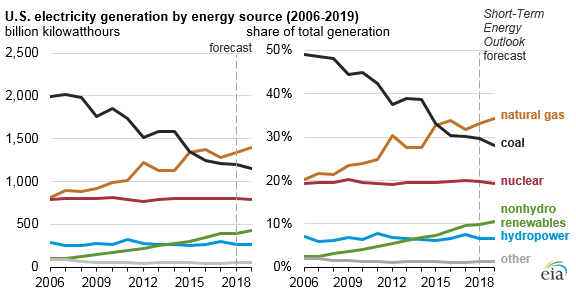 Source: EIAThe EIA expects the share of generation from coal to average 30 percent in 2018 and 28 percent in 2019. That compares with 30 percent in 2017.
The mix of energy sources used to produce electricity continues to shift in response to changes in fuel costs and the development of renewable energy technologies, the EIA said. Since 2015, the cost of natural gas delivered to electric generators has generally averaged $3.50 per million British thermal units (Btu) or less. It is expected to remain near this level through 2019.
The average cost of natural gas delivered to generators in 2018 is forecast to fall 2 percent, while the forecast delivered cost of coal rises by 5 percent. These relative price changes should increase the share of natural gas generation in 2018, the EIA says. The costs of both natural gas and coal in 2019 are expected to remain relatively unchanged from 2018 forecast prices.
Capacity Surge
Power plant operators are scheduled to bring 20 gigawatts (GW) of new natural gas-fired generating capacity online in 2018. If realized, the addition would be the largest increase in natural gas capacity since 2004.
 Source: EIAAlmost 6 GW of the capacity additions are being built in Pennsylvania, and more than 2 GW are being built in Texas. In contrast, about 13 GW of coal-fired capacity is scheduled to be retired in 2018.
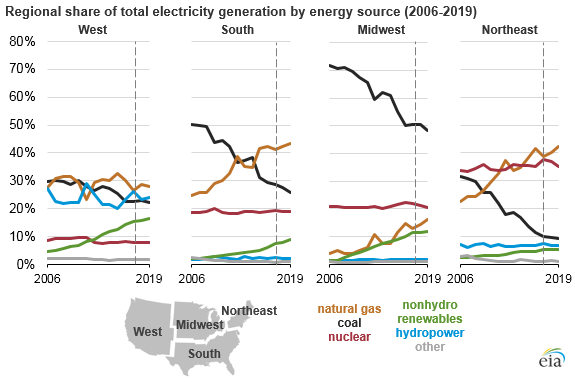
Compared with the rest of the country, the use of natural gas for electricity generation is not expected to increase as much in the west, where natural gas largely competes with hydropower. The EIA expects the natural gas generation share in the west region to rise from 27 percent in 2017 to 29 percent in 2018. This increase is largely the result of a decline of the region’s hydropower generation share, which is expected to fall from 26 percent in 2017 to 23 percent in 2018.
The EIA also expects the average annual U.S. share of total utility-scale generation from nonhydro renewables to exceed 10 percent for the first time in 2019.