Grid Can Handle High Stress Conditions, PJM Says
David Wagman | November 02, 2018Grid operator PJM said that the system serving 65 million people in 13 states and the District of Columbia can withstand "extended periods of highly stressed conditions" that might occur if electric power generators' fuel supply was disrupted for a long period of time.
In a new analysis, the grid operator says that it also identified instances in which the system would face power outages using what it says are extreme but "reasonably plausible assumptions" about weather, customer demand, power plant retirements and fuel availability.
 The 908 MW Davis-Besse nuclear plant in Ohio is set to close in May 2020. Source: FirstEnergy SolutionsReliability has been a concern in the region as market conditions have led to a string of power plant retirements involving coal and nuclear generating resources. At the same time, abundant and relatively low-cost supplies of natural gas have favored deployment of combined cycle gas turbine and other gas-fired technologies.
A Federal Bailout?
Those same market issues prompted efforts at the Department of Energy (DOE) to devise a plan to support potentially vulnerable coal and nuclear assets. Regulators at the Federal Energy Regulatory Commission (FERC) in January turned back an initial policy proposal. And news reports in recent weeks have suggested that the White House has cooled somewhat on the idea of providing support for coal and nuclear. The naming of Neil Chatterjee in October as FERC chair could change that outlook, however, as he is considered to be sympathetic to calls for what some critics label as a bailout of economically challenged electric generating assets.
 PJM operates the electric grid that serves 65 million people in 13 states. Source: PJMIn August, FirstEnergy Solutions Corp. told PJM officials that it plans to deactivate four fossil-fired power plants in 2021 and 2022, and three nuclear power stations in 2020 and 2021. The power generator blamed what it said was "a market environment that fails to adequately compensate generators for the resiliency and fuel-security attributes that the plants provide."
 Source: EIAThe FirstEnergy power plants represent some 4,017 megawatts (MW) of fossil-fired generating capacity and 4,061 MW of nuclear generating capacity.
"As with nuclear, our fossil-fueled plants face the insurmountable challenge of a market that does not sufficiently value their contribution to the security and flexibility of our power system," said Don Moul, president of FES Generation Companies and chief nuclear officer. He said that the market fails to recognize the on-site fuel storage capability of coal, "which increases the resilience of the grid."
Stress Test
PJM said that its reliability analysis was intended to stress the grid system using more than 300 scenarios that could occur from 2023 into the future. The analysis found that in a sustained period of cold weather with typical customer demand, PJM’s system can operate reliably over an extended period of stress. PJM said that it also found stress points, starting in 2023, which could result in "material levels of generation unavailability and load shedding," meaning brownouts and blackouts.
 Source: EIAIn extreme scenarios, the more the grid was stressed, the more important fuel supply characteristics, location of the fuel supply disruption and demand response became, said Michael Bryson, vice president of operations. “We believe that some changes to the system in the future — both market-based and operational — are warranted."
The study identifies a number of variables that are important to the grid’s fuel supply security, including:
- Availability of non-firm gas service
- Ability of the fuel-oil delivery system to replenish oil supplies during an extended period of extreme cold weather
- Physical breaks at key locations on the pipeline system
- Customer demand (load)
- Generator retirements, replacements and resulting installed reserve margin
- Use of operating procedures to conserve fuel during peak winter conditions
Movement Toward Gas
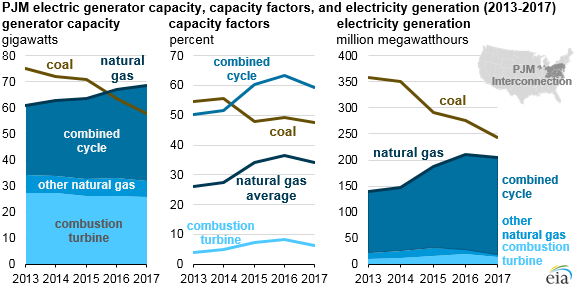
Analysis by DOE's Energy Information Administration (EIA) in October said that the average annual capacity factors for natural gas-fired generators in PJM Interconnection have increased in recent years, reflecting greater use of natural gas-fired generators in the region.
The increase in PJM’s capacity factors for natural gas-fired generators is the largest of any regional transmission organization in the country in the past five years (2013–2017), EIA said. Capacity factors indicate how often a generator is run. The combination of additions of natural gas-fired capacity in the region and higher capacity factors have meant that utilities in PJM have been generating more electricity using natural gas.
Much of the increase in generation from natural gas is from generating units using combined-cycle technology. By comparison, the use of natural gas-fired combustion turbines in PJM has remained relatively constant, EIA said.
Average annual capacity factors for natural gas-fired combined-cycle generators in PJM first passed those of coal-fired generators in 2015. Relatively lower natural gas prices have been a primary driver for rising natural gas capacity factors.
Cost Advantage
According to EIA, the monthly average cost of Central Appalachian coal in the PJM region averaged $2.76 per million British thermal unit (MMBtu) in 2013 and $3.30/MMBtu in 2017. In contrast, the monthly average price of natural gas at the Texas Eastern Transmission Market Zone 3 (TETCO M-3) hub, which generally reflects natural gas prices in Pennsylvania, New Jersey and New York, fell below the price of coal on a dollar-per-MMBtu basis in mid-2014. With the exception of winter price spikes, EIA said that the price of natural gas has remained lower than the price of coal since then.
PJM said that it now will work with its stakeholders to examine the findings and explore market-based solutions to address concerns about long-term fuel supply security. PJM said that it expects to have a problem statement presented to stakeholders in early 2019, with any potential market rule changes targeted for filing with the FERC in early 2020.