NASA Launches Next-Generation Weather Satellite
S. Himmelstein | November 18, 2017NASA has launched a next-generation satellite designed to monitor global weather and help improve forecasts up to seven days. The Joint Polar Satellite System-1 (JPSS-1) is a joint venture between the space agency and the U.S. National Oceanic and Atmospheric Administration (NOAA).
It was launched aboard a United Launch Alliance Delta II rocket on November 18, 2017 from Vandenberg Air Force Base in California. The satellite will orbit the Earth 14 times each day from one pole to the other at 512 miles (824 kilometers) above the planet, providing scientists full global coverage twice a day.
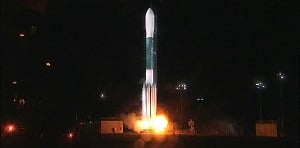 At Vandenberg Air Force Base's Space Launch Complex 2, the Delta II rocket engines roar to life during liftoff of the Joint Polar Satellite System-1. (Credit: NASA)The solar arrays on JPSS-1 deployed about 63 minutes after launch, enabling the spacecraft to operate on its own power. JPSS-1 will join the joint NOAA/NASA Suomi National Polar-orbiting Partnership satellite in the same orbit and provide meteorologists with observations of atmospheric temperature and moisture, clouds, sea-surface temperature, ocean color, sea ice cover, volcanic ash, and fire detection.
The data will improve weather forecasting, such as predicting a hurricane’s track, and will help agencies involved with post-storm recovery by visualizing storm damage and the geographic extent of power outages. The measurements will also improve recognition of climate patterns that influence the weather, such as El Nino and La Nina.
Five instruments are onboard, each of which is significantly upgraded from those on NOAA’s previous polar-orbiting satellites. Ball Aerospace designed and built the JPSS-1 satellite bus and Ozone Mapping and Profiler Suite instrument, integrated all of the spacecraft’s instruments and performed satellite-level testing and launch support. Raytheon Corporation built the Visible Infrared Imaging Radiometer Suite and the Common Ground System. Harris Corporation built the Cross-track Infrared Sounder. Northrop Grumman Aerospace Systems built the Advanced Technology Microwave Sounder and the Clouds and the Earth's Radiant Energy System instrument.
JPSS-1 will be renamed NOAA-20 when it reaches its final orbit. Following a three month checkout and validation of its advanced instruments, the satellite will become operational.