Flexible Semi-Transparent Solar Cells Fabricated Using Atomically Thin 2D Materials
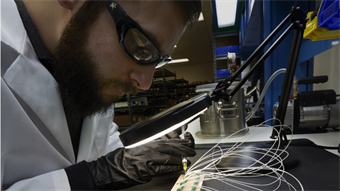
Peter Brown | September 28, 2017 The prototype solar cell. Source: Tohoku University
Researchers at Tohoku University have developed a new method for fabricating semi-transparent and flexible solar cells using atomically thin 2D materials.
The new technology ups the power conversion efficiency to 0.7 percent, which researchers claim is the highest value for solar cells made from transparent 2D sheet materials. These solar cells can be used for various applications such as window surfaces, front display PC panels and cell phones or even on human skin.
Researchers used transition metal dichalcogenides (TMDs), an atomically thin 2D material and Schottky-type configuration, to achieve the power conversion efficiency increase to 0.7 percent. Clear power generation was also observed for a device fabricated on a large transparent and flexible substrate.
"Since our device structure, Schottky-type solar cell, is very simple, the TMDs-based Schottky-type solar cell possesses good properties for scalability, which is one of the most important elements for use in practical applications." says t. Kato, associate professor at Tohoku University. "The transparent and semi-transparent solar cell can be used in a variety of ways. This new type of solar cell is likely to have impact on the technologies we use in daily life in the near future."
Researchers warn that there are still issues with the technology in regards to power conversion efficiency, optical transparency, flexibility, stability and scalability.
The full research can be found in the journal Scientific Reports.