
UPS to Deliver with Extended Range Fuel Cell Vehicles
S. Himmelstein | May 02, 2017The United Parcel Service of America (UPS) is working with the U.S. Department of Energy (DOE) and other partners to design a first-of-its-kind, zero tailpipe emissions, Class 6 medium-duty delivery truck that meets the same route and range requirements of UPS’s existing conventional fuel vehicles. The company plans to deploy a prototype extended range Fuel Cell Electric Vehicle (FCEV) in its Rolling Laboratory fleet of alternative fuel and advanced technology vehicles.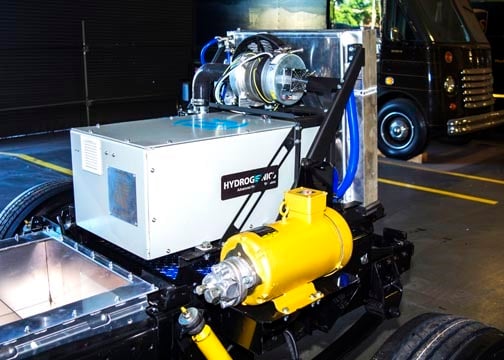 Fuel cell electric vehicle chassis. Source: UPS
The first FCEV prototype will be placed into service in Sacramento, CA, where UPS will validate its design and core performance requirements by testing it on the street starting the third quarter of 2017. Current project plans call for additional UPS trucks to be validated with at least 5,000 hours of in-service operational performance. All of the trucks will be deployed in California due to that state’s ongoing investment in zero tailpipe emissions transportation and installment of hydrogen fueling stations around the state.
Each FCEV produces electricity which continuously charges the batteries, thereby providing additional power and an extended range of 125 miles. The UPS trucks are equipped with a 32 kilowatt hydrogenics fuel cell coupled to 45 kilowatt hours of battery storage and 10 kilograms of hydrogen fuel. The drive train runs on electricity supplied by batteries.
The initiative, part of a fuel cell project grant awarded by DOE in 2013 to verify the proof of concept in commercial delivery vehicles, calls for retrofitting conventional fuel trucks with fuel cell systems designed specifically for use in a delivery truck duty cycle. UPS is partnering with the Center for Transportation and the Environment, as well as Unique Electric Solutions LLC and the University of Texas’ Center for Electromechanics.


Now if we can just get something with more electric output per Kg than hydrogen, or generate the hydrogen on-board through a chemico-electrical process, then it is really off to the races.
For example, if Aluminum can be re-processed (and it can, it just takes energy and the will to do it), then the new charge storage Aluminum anode battery (carbon cathode with complexed aluminum ions intercalated), that is completely re-chargeable could be a real contender. Another option is hydrogen from aluminum, that is advancing technology, beyond the mere reaction of aluminum metal with caustic solutions.
Hydrogen generation cassettes could be changed out back at depot.
So could expended batteries that need re-charging for that matter.