Mini Medical Agents: Self-Propelled Nanojets
Engineering360 News Desk | April 02, 2017Two propulsion protocols for miniature robots under development may broaden biomedical applications for nanorobots.
One approach uses ultrasound to oscillate bubbles in order to realize forward motion, and the other relies on an enzymatic reaction to produce a current and propel a nanoswimmer.
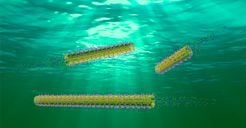 Enzyme-propelled nanorobots. © MPI for Intelligent SystemsAn underwater-nanorobot engineered at Max Planck Institute for Intelligent Systems in Stuttgart, Germany, is a single-walled, 220 nm-diameter nanotube made of silicon dioxide. The inner surface or both inner and outer surfaces are coated with the enzyme urease, which breaks down urea into ammonia and carbon dioxide.
When the nanotube is submerged in a fluid containing urea, the latter is broken down at the urease-coated internal wall. The resulting reaction products generate a current in the fluid which propels them out of the tube like a jet. As such a nanoswimmer either is thinner at one end than at the other or the urea is not distributed homogeneously over its surface, resulting in a thrust that moves the micro-swimmer in the opposite direction. Speeds of 10 μm/second, or 4 cm/hour, are achieved.
Micro-bubbles enclosed in small cylindrical chambers along a plastic strip are the motive force in another approach. The gas bubbles expand and contract cyclically as ultrasound causes them to oscillate. The pulsating bubbles expand through a single opening in the chamber, exerting a force on the opposite chamber wall which propels the plastic strip.
The sound wave frequency required to cause oscillation depends on bubble size: the bigger the bubbles, the smaller the corresponding resonant frequency. Two different sound frequencies were applied in a liquid to each cause all the bubbles of one size to oscillate. The small acoustically driven rotation motor with longitudinal areas 5 sq mm in size achieved up to a thousand rotations per minute in the process.
These mini engines may eventually be attached to devices that deliver drugs or perform some other diagnostic or therapeutic task.