
SKF Corrosion-Resistant Spherical Roller Bearings
Ken Thayer | March 30, 2017
 Image credit: SKF USA Inc.SKF is manufacturing the first-ever corrosion-resistant steel spherical roller bearings, available in nine standard sizes. These bearings are manufactured from High Nitrogen Corrosion Resistant (HNCR) stainless steel, which has been in development for the past eight years. Although HNCR is still expensive, it is the first stainless steel that is hardenable to 58 HRC, the same degree as 52100 high carbon bearing steel.
The standard size line of HNCR spherical roller bearings are primarily targeted for use in the pulp and paper industry for wet section felt rolls, black liquor applications and wire return applications. Unplanned shutdowns of a paper mill due to bearing failure can be as expensive as $25,000 per hour. According to industry averages, the typical paper mill has two four-hour, unplanned shutdowns per year due to bearing failure in felt rolls. This translates to an annual cost of up to $200,000. The life expectation and corrosion resistance of an HNCR bearing is far superior to that of a 440C stainless bearing, which results in reduced unplanned downtime and maintenance costs and increased productivity.
In addition to pulp and paper mill applications, HNCR bearings have been custom engineered for corrosive applications such as ice cream manufacturing and pharmaceutical sanitizer racks.
The first HNCR bearings to be used in production have been running for over seven years at a paper mill in Florida. The typical life expectancy in this application is 36 months. The bearings were inspected after five years of continual service for inspection and showed no signs of service distress.
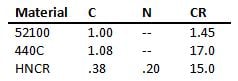
A martensitic through-hardened stainless steel, HNCR can also be case-hardened. HNCR also provides superior corrosion resistance over and above that of 440C stainless steel due to the introduction of nitrogen. Other bearing steel alternatives, such as 52100 and 440C stainless steel, contain no nitrogen at all. HNCR also offers greater material "cleanliness" and a more homogeneous structure compared to 440C.


A bit of ni,moly and tungsten will improve performance.